Wednesday, February 26, 2014

Orville Wright's "True" Fiction for the Boy Scouts and for "Very Young People"

 To make your children capable of honesty is the beginning of education.
~ John Ruskin

In previous posts, we have been questioning the truth of aviation history as it's presented by the brothers Wright.

Was Orville or Wilbur the first to fly?

At the time of his death in 1912, Wilbur had been named the "first to fly," for the simple reason that the first three claimed flights of the Wright brothers December 17, 1903, weren't considered long enough to be called "sustained." Both brothers had said that Wilbur made the fourth flight, lasting 57-59 seconds.

But soon after Wilbur's death, in a 1914 Boys' Life magazine, an article credited to Orville Wright was published where he claimed it was he who made the longest reported flight of 57 seconds instead of his brother, Wilbur. Why is this significant? For one reason, the brothers themselves didn't accept the first three shorter "flights"as true flights. (This will be addressed in a later post). It would appear that Orville wanted to be remembered as first to fly--even if he stole the longest flight and the crown from his brother.

Did Orville know about the error(s) in the article?

Orville Wright advocates could say that the untruths (there were other discrepancies) in the article slipped by Orville's eagle eye, and/or they might blame the errors on the magazine itself. It's a fact that journalists often make mistakes in their publications. But it's easy enough to prove that both Orville and Wilbur kept close track of publications about themselves, as I mentioned in former posts. If they didn't like what was written, they demanded a change. And without a doubt, Orville knew about discrepancies.
                             
 "The article was never corrected by me..." Orville Wright in 1942 (From Wright letters, the Library of Congress)

Orville was replying to a query by a  Mr. Max J. Herzberg, who wanted to include Orville's 1914 Boys' Life article in an anthology.

" Dear Mr. Herzberg:-
               How I learned to fly" was written in 1914 by Leslie W. Quirk...for "Boys' Life Magazine" after an interview with me. The article was never corrected by me and has many inaccuracies....
  If the anthology is for very young people the seriousness of the inaccuracies is not so important...."

In contrast we have this excerpt from another letter  Orville wrote to Mr Herzberg on June 26, 1942, (Wright letters, Library of Congress)
"Dear Mr. Herzberg: I beg to acknowledge receipt of your letter of June 20th asking permission to publish an article which appeared, as though written by my brother Wilbur, in "The Independent" of February 4, 1904. This was a forgery, written by a  D. A. Will of Baltimore, Maryland. 
The facts were brought to the attention of Hamilton Holt, editor of "The  Independent". Holt had two other cases similar to this on his hands at the time. I do not know what he did in regard to the others, but in my brother's case he was not man enough to make a full and open correction as an honest editor should have done. As a result you and others have been deceived. And Holt has become the president of a college to instruct the youth of America!..." *
To repeat:
"(Holt) was not man enough to make a full and open correction as an honest editor should have done." --Orville Wright, 1942 *

What can we deduct from these letters, side by side? In my opinion, they display a glaring hypocrisy and a double standard on the part of Orville. The July 11 letter proves that Orville was long aware of what he called "inaccuracies" in the Boys' Life article, but he says he never "got around" to correcting them. As for the "Independent" article, however, Orville declares that the editor, Hamilton Holt, isn't "man enough" to correct its inaccuracies openly and now he's going to "instruct the youth of America." As for his own instruction of the youth of  America, Orville gives himself a pass.  His  deception of editors, young people, and the Boy Scouts "is not so important."

As we shall see in the next post, not only do some of the so called "errors" in the Boys' Life story inflate Orville Wright as a pioneer above his own brother, but they also demean the great aviation pioneers, Lilienthal and Octave Chanute.

In December, 1928, "Boys' Life" published the Orville Wright story again.

It's ironic that by this time Orville Wright had been declared  an "honorary Boy Scout" because "The mission of the Boy Scouts of America is to prepare young people to make ethical and moral choices over their lifetimes by instilling in them the values of the Scout Oath and Law." 

The first law is:
"TRUSTWORTHY. A Scout tells the truth. He keeps his promises. Honesty is part of his code of conduct. People can depend on him."


  The 1928 magazine article was embellished with many more pictures depicting the Wrights' early experiments. None of the  major errors in the story had been corrected either by the editor Quirk or by Orville. Orville still got credit for the longest flight at Kill Devil Hills.
First page of Boys' Life article, 1928, by Orville Wright


Second page of Boys' Life article, 1928
But Orville had made at least one correction. In the last page (below) of the 1928 article, he left out his 1914 statement that after the longest flight, he was ready to fly again right away. It could hardly be true if, as stated in the previous stories, the pilot hit a hummock of sand after the longest flight, breaking the front elevator supports and braces.

Clip from 1914 Boys' Life article

Clip from 1928 Boys' Life article
In conclusion, I believe I have clearly enough demonstrated that the Boys' Life articles were authorized by Orville Wright.

 In 1948 Orville died. The Boys' Life article "How I Learned to Fly" has been reprinted a number of times since his death. In 2010 it was reprinted in a book called "The Best of Boys' Life." Either the magazine is unaware of the many errors in it, or it doesn't feel it's necessary to correct them. I strongly believe the editors should correct them in the best tradition of the Boy Scout's first law.

 It is particularly troubling to confront such callousness about truth in the Wright saga when we begin to examine both brothers' attempts and often successes in maligning and discrediting some of our greatest pioneer aviators. One example is Glenn Hammond Curtiss, who was defamed by Orville Wright after Curtiss's death. Other examples are Gustave Whitehead and John Montgomery.

Boys' Life 1928 last page with clip describing longest flight


To be continued ...
_______________________

*True to form, a day after the 1904 article in the "Independent" came out, Wilbur attacked the editor Holt in a letter. Holt responded by making an apology three weeks later, according to Fred Howard in his biography of the Wright Brothers, Orville and Wilbur, page 150.  But Holt's apology wasn't good enough. So Wilbur attacked the author of the article and received another apology from the editor. None of Holt's endeavors was acceptable to the Wrights.

Thursday, January 30, 2014

Didn't the Wright Brothers Always Tell the Truth? Part 2


"What we need is not the will to believe but the will to find out." - Bertrand Russell
                    "Only a fool of a scientist would dismiss the evidence and reports
                     in front of him and substitute his own beliefs in their place."
                                                 - Paul Kurtz

  
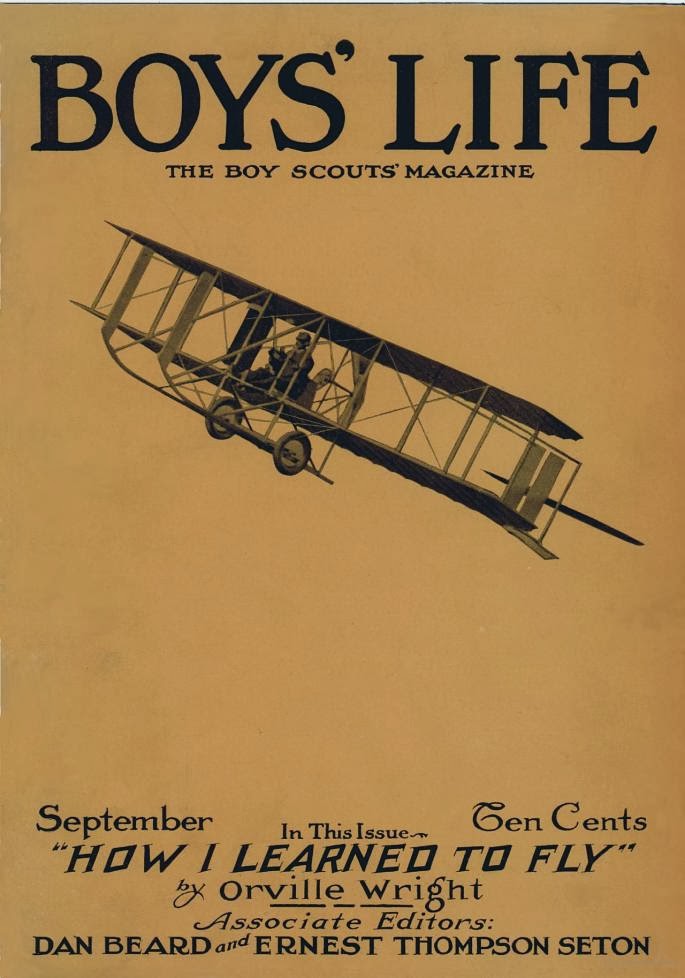
The cover of Boys' Life magazine Sept., 1914


 Historians and the public, who want to believe the Wrights were first to fly, have many excuses for  inconsistencies in witness's descriptions of` what happened at Kill Devil Hills, N.C.,  Dec.14-17, 1903--and indeed, later.  For examples: "Witnesses couldn't remember," or, "Their statements were made years after the facts."

This, of course, implies that the only statements we can rely on, according to these historians, are the statements of the Wrights, themselves. But what if the Wrights contradict themselves? Then even the historians have a dilemma.
Fast forward to the year 1914. It's important to note that Wilbur has died in 1912 of typhoid. Orville has gone into debt to buy back the stock of the Wright company. He plans to sell to another group of investors in Dayton. The  disgruntled stockholders of the original company are glad to sell, because they have found that Orville is unable, or refuses, to attend to business, and the Wright Company has been run into the ground. This despite the fact that in January, 1914, the company has paid for and won the final judgement against Glenn Curtiss in his last appeal against the Wright lawsuits.  Now Orville needs to collect money from all of his patent infringers. Which, apparently, according to the judges, includes every single aviator who dares to fly and make any money in the business.

But Orville wants out of the aviation business. What does he want? One clue is in an interview Orville gives to Boys' Life, the magazine of the Boy Scouts of America.  Among other glaring inconsistencies with the Wright brothers' previous narrations of their first "flights" is Orville's new story. He tells the Boy Scouts that he was the one who made the last and longest claimed flight on December 17. Orville has the byline. So we have to assume from his past history that Orville either "approves" of the story, or somehow doesn't know about the many discrepancies in it. This is difficult to believe and he has ample opportunity to correct it. To easily read the full story, please click the link to Boys' Life.

Boys' Life Magazine, 1914, which includes Orville's story of the "first flight"


In a previous entry, we established that the Wrights official statement about the claimed flights December 17, 1903, was as follows

1. Orville-- estimated 120 feet (100 feet beyond the track)--12 seconds

2. Wilbur--estimated 175 feet--13 seconds

3. Orville--estimated 200 feet--15 seconds

4. Wilbur --measured 852 feet--59 seconds

According to their joint story, Wilbur won a coin toss and made the first attempt on December 14, but he failed to fly and broke some parts of the plane. Then after repairs, it was Orville's turn to go first on the 17th. So, second that day was Wilbur's turn, third was Orville's, and the fourth and last was Wilbur's. It's important to note that when he was alive, it was Wilbur who was given credit for the only flight that is considered long enough by some, including Tom Crouch, to be considered "sustained," the flight of  852 feet. But then, of course, to be a flight, it would have had to be made from level ground like the Wrights said, not from a hill, assisted by gravity--as witnesses Daniels and Etheridge stated.       


Boys' Life Magazine, page 2
Boy's Life Magazine, page 3

Boys' Life, page 4, where Orville claims the longest flight of 1903 from his own brother

The circled section on the last page, page 4, of the Boys' Life article (above) by Orville Wright is transcribed below. Note, as stated, that Orville gives himself credit for the last and longest flight (57-59 seconds) that has been credited to Wilbur before. But Wilbur has died and can't correct his brother.
"The usual visitors did not come to watch us that day. Nobody imagined we would attempt a flight in such weather, for it was not only blowing hard, but it was also very cold. But just that fact coupled with the knowledge that winter and its gales would be on top of us almost any time now made us decide not to postpone the attempt any longer.

My brother climbed into the machine. The motor was started.  With a short dash down the runway the machine lifted into the air and was flying. It was only a flight of twelve seconds, and it was an uncertain wavy, creeping sort of a flight at best, but it was a real flight at last and not a glide.

Then it was my turn. I had learned a little from watching my brother, but I found the machine pointing upward and downward in jerky undulations. This erratic course was due in part to my utter lack of experience in controlling a flying machine and in part to a new system of controls we had adopted, whereby a slight touch accomplished what a hard jerk or tug made necessary in the past. Naturally, I overdid everything but I flew for about the same time my brother had.

 He tried it again the minute the men had carried it back to the runway, and added perhaps three or four seconds to the records we had just made. Then after a few secondary adjustments, I took my seat for the second time. By now I had learned something about the controls, and about how a machine acted during a sustained flight, and I managed to keep in the air for fifty-seven seconds.
I couldn't turn, of course--the hills wouldn't permit that--but I had no great difficult in handling it. When I came down I was eager to have another turn...."

 Now  compare this account with the account in Orville's diary as follows:

  " Thursday, Dec. 17 - When we got up a wind of between 20 and 25 miles was blowing from the north. We got the machine out early and put out signal for the men at the station. Before we were quite ready John T. Daniels, W.S. Dough, A. D. Esteridge, W.C. Brinkley of Manteo and Johnny Moore of Nag's Head arrived. After running the engine and propellors a few minutes to get them in working order, I got on the machine at 10:35 for the first trial. The wind, according to our anemometers at this time, was blowing a little over 20 miles (corrected) 27 miles according to the Government anemometer at Kitty Hawk. On slipping the rope the machine started off increasing in speed to probably 7 or 8 miles. The machine lifted from the truck just as it was entering on the fourth rail. Mr. Daniels took a picture just as it left the tracks. I found the control of the front rudder quite difficult on account of its being balanced too near the center and thus had a tendency to turn itself when stated so that the rudder was turned too far on one side and then too far on the other. As a result the machine would rise suddenly to about 10 ft. and then as suddenly, on turning the rudder, dart for the ground. A sudden dart when out about 100 feet from the end of the tracks ended the flight. Time about 12 seconds (not know exactly as watch was not promptly stopped). The lever for throwing off the engine was broken, and the skid under the rudder cracked. After repairs, at 20 min. after 11 o'clock Will made the second trial. The course was about like mine, up and down but a little longer over the ground though about the same time. Dist. not measured but about 175 ft. Wind speed not quite so strong. With the aid of the station men present, we picked the machine up and carried it back to the starting ways. At about 20 minutes till 12 o'clock I made the third trial. When out about the same distance as Will's, I met with a strong gust from the left which raised the left wing and sidled the machine off to the right in a lively manner. I immediately turned the rudder to bring the machine down and then worked the end control. Much to our surprise, on reaching the ground the left wing struck first, showing the lateral control of this machine much more effective than on any of our former ones. At the time of its sidling it raised 12 to 14 feet. At just 12 o'clock Will started on the fourth and last trip. The machine started off with its ups and downs as as it had before, but by the time he had gone over three or four hundred feet he had it under much better control, and was traveling on a fairly even course it proceeded in this manner till it reached a small hummock out about 800 feet from the starting ways, when it began its pitching again and suddenly darted into the ground. The front rudder frame was badly broken up, but the main frame scuffed none at all. The distance over the ground was 852 feet in 59 seconds."

http://www.libraries.wright.edu/special/wright_brothers/info_packet/images/primary_sources/1903_diaries_286287.jpg
Pages of Orville Wright's diary in which he details another version of the December 17, 1903 flights


Again, given that Orville Wright was a watchdog when it came to getting publications "right," it's a fair bet that he was aware of the multiple contradictions in the "Boys' Life" magazine to earlier statements both brothers made.   But can we prove Orville knew about the "errors"? See the next post

. To be continued.


Sunday, January 26, 2014

Didn't the Wright Brothers Aways Tell the Truth? Part 1


  "The fact that an opinion has been widely held is no evidence whatever 
that it is not utterly absurd; indeed in view of the silliness of the 
majority of mankind, a widespread belief is more likely to be foolish 
than sensible."  -Bertrand Russell

      "All great truths begin as blasphemies." - George Bernard Shaw 


A good many historians today base their version of early aviation history on the statements of the Wright Brothers. But a critical thinker has to establish that we can depend on the Wrights' honesty and consistency, especially since we have already established that their descriptions of the first claimed flights are not consistent with those of two of their five witnesses. The Wrights say they took off from level ground on December 17, 1903. Witnesses Daniels and Etheridge state that they placed the plane on the side of the hill for the claimed flights that day. What do later publications, documents and letters tell us about truth in the Wrights' statements?

In a New York Times article dated 1951 (below), telegraph operator Alpheus Drinkwater stated that the Wrights didn't really fly; they only "glided" off Kill Devil Hill on December 17. Note that his statement backs up Daniels and Etheridge--that the "flights" were initiated from the hill. Drinkwater wasn't named by the Wrights as a direct witness of the first flights, as the article indicates. Still, his statement adds to doubts, since he was operating a telegraph in the area and news in a sparsely populated area gets around quickly.

Because Drinkwater's statement was made after Orville Wright died in 1948, Orville wasn't here to"correct" it. And ferreting out and correcting what he claimed were "errors" was a chore Orville  indulged in for 45 years. (Not inventing as he claimed he wanted to do.) You might say monitoring aviation news was one of his life's missions. Or you could say manipulating history in his favor was really Orville Wright's mission.

 From the beginning, the Wrights were acutely aware of  published accounts about themselves and their claimed achievements. Their scrapbooks are one testimony to that fact. And if they didn't like the writing, they weren't afraid to be very aggressive in getting the "story right" by contacting  writers, editors, and/or publishers.

The first published accounts of the December 17, 1903,  events at Kitty Hawk (actually Kill Devil Hills) were in newspapers the next day on the 18th. The telegram the brothers sent to their father, the Bishop after their claimed flights stated "Inform press," so we can be assured that the Wrights wanted the press to know they claimed they had flown. Many of the news articles were based, for the most part, on the telegram, so this backs up that the Wright family did get what the brothers told them to the papers.

But one account was mostly a fantastic story concocted by newsmen, including H. P. Moore, of the Virginia Pilot news (see link for article), who had gotten wind of the claimed flights December 17.  How they got their tip is subject to speculation, but there are some documents that can later help to clear it up. Short on facts and long on imagination, the newsmen wanted to scoop the story and made up what they didn't know. This story was picked up by other papers.


On January 5, the Wright brothers responded to the Virginia Pilot article by releasing to the news a fresh account. This personal version of the events of Dec.17 was given to the Associated Press to distribute. Their statement detailed more than previous accounts and made the events more believable.

As time went on, they would essentially need to stick to this account. Moreover, it would need to mesh with the account they had sent to their father in the telegram. "Four flights... all against twenty one mile wind started from level with engine power alone..."

From a written statement by the Wright brothers to the Associated Press, January 5, 1904
 "It had not been our intention to make any detailed public statement concerning the private trials of our power “Flyer” on the 17th of December last; but since the contents of a private telegram, announcing to our folks at home the success of our trials, was dishonestly communicated to the newspapermen at the Norfolk office, and led to the imposition upon the public, by persons who never saw the “Flyer” or its flights, of a fictitious story incorrect in almost every detail; and since this story together with several pretended interviews or statements, which were fakes pure and simple, have been very widely disseminated, we feel impelled to make some correction.  The real facts were as follows:
On the morning of December 17th, between the hours of 10:30 o’clock and noon, four flights were made, two by Orville Wright, two by Wilbur Wright.  The starts were all made from a point on the level sand about two hundred feet west of our camp, which is located a quarter of a mile north of the Kill Devil sand hill, in Dare County, North Carolina.  The wind at the time of the flights had a velocity of 27 miles an hour at ten o’clock, and 24 miles an hour at noon, as recorded by the anemometer at the Kitty Hawk Weather Bureau Station.  The anemometer is thirty feet from the ground.  Our own measurements, made with a hand anemometer at a height of four feet from the ground, showed a velocity of about 22 miles when the first flight was made, and 20 ½ miles at the time of the last one.  The flights were directly against the wind.  Each time the machine started from the level ground by its own power alone with no assistance from gravity, or any other source whatever.  After a run of about 40 feet along a monorail track, which held the machine eight inches from the ground, it rose from the track and under the direction of the operator climbed upward on an inclined course till a height of eight or ten feet from the ground was reached, after which the course was kept as near horizontal as the wind gusts and the limited skill of the operator would permit.  Into the teeth of a December gale the “Flyer” made its way forward with a speed of ten miles an hour over the ground and thirty to thirty-five miles an hour through the air.  It had previously been decided that for reasons of personal safety these first trials should be made as close to the ground as possible.  The height chosen was scarcely sufficient for maneuvering in so gusty a wind and with no previous acquaintance with the conduct of the machine and its controlling mechanisms. 
       Consequently the first flight was short.  The succeeding flights rapidly increased in length and at the fourth trial a flight of fifty-nine seconds was made, in which time the machine flew a little more than a half mile through the air, and a distance of 852 feet over the ground.  The landing was due to a slight error of judgment on the part of the aviator.  After passing over a little hummock of sand, in attempting to bring the machine down to the desired height, the operator turned the rudder too far; and the machine turned downward more quickly than had been expected.  The reverse movement of the rudder was a fraction of a second too late to prevent the machine from touching the ground and thus ending the flight.  The whole occurrence occupied little, if any, more than one second of time."

We also have Orville's diary account of the day's events coming up, neatly written in his journal. At what period of time he made that entry in his journal, who knows? But these accounts give us a base line to establish the Wrights' veracity. They have to be accepted as their official statement.

Keep in mind that no matter how many times they said it or published it, including the account in the telegram, the news account of Jan 5 released to the AP,  the entry in Orville's journal, and letters written to various people, it is the Wright brothers' account. There were no reporters there, only the five witnesses. All of the newspaper accounts were based on what the Wrights told them, or as in some cases, wildly fabricated. The Wrights' account is essentially the same account you will read in blogs, history books, Wright biographies, and the like. But common sense tells us that repeating a tale over and over again, asserted by brothers who had a lot to gain, simply doesn't make it the truth.

We need to examine whether the Wrights were consistent with their first accounts, as time went on.

Moreover, among the questions that also come up are: (a) whether the Wrights themselves really believed the four claimed flights were actually flights; (b) whether in fact, four flights were actually attempted that day, as other accounts contradict that claim; and

(c) whether the Wrights in truth packed up all the broken pieces of the original Wright flyer after it was wrecked, took them home, and stored them, later to be rebuilt and put on display. Some witness accounts even question that claim.

                                                             To be continued...


Tuesday, December 3, 2013

Did the Wrights Really Fly in 1903? An Expert Opinion by Tom Crouch, Curator of NASM, Smithsonian Institution

..."Was the first Wright flight of December 17, 1903 (120 feet) sustained? Probably not...."--Tom Crouch
 Were the Wright brothers the first to fly as we've been taught in our
 public schools? Orville Wright claimed that they made four actual flights on December 17, 1903, at Kill Devil Hills near Kitty Hawk, North Carolina.

On December 14 Wilbur failed in the first attempt to fly  He had won the coin toss for the first trial but he quickly lost control of the plane and it crashed. After repairing the plane, they decided to try again on the cold, windy day of December 17. Since Wilbur got the first shot on the 14th, it was Orville's turn to try first.

These are the flights he claimed they made:

1. Orville-- estimated 120 feet (100 feet beyond the track)--12 seconds
2. Wilbur--estimated 175 feet--13 seconds
3. Orville--estimated 200 feet--15 seconds
4. Wilbur --measured 852 feet--59 seconds

But did they really fly?

Below is the opinion of Tom Crouch, Senior Curator of the National Air and Space Museum of the Smithsonian Institution. Crouch actually states that he doesn't consider the first flight by Orville a flight, according to his definition of a true flight.. Also note that the 852 feet flight can only be considered a flight if it was not launched from a hill. But the witnesses of these flights, who made statements, agreed that the flights were made from the hill.In this case, none of the flights were true flights. See blog post, " The Wright Story, Not So Sure," Nov 1, 2013.


" You  raise the question of Herring....He was in the air less than 100 feet.... There is no doubt in my mind that Herring was off the ground. So were Mozhalsky, Maxim, du Temple and others. They were not, however, flying. Call it hopping, or anything else you want, but please do not call it flying."
-- Tom Crouch


If the first flight at Kitty Hawk made by Orville Wright on December 17, 1903, was not a true flight, as Tom Crouch of the Smithsonian states, then the famous picture that the Smithsonian tells us is a record of the first flight in history is actually not. It doesn't matter when it was taken or by whom.

Sunday, November 17, 2013

The "First Flight" Picture: Puzzling Questions


A close study of the iconic picture (third picture, below) of the 1903 Wright flyer reveals strange anomalies. If you observe the cast shadows, you can easily see that they are contradictory. 
A bright, sunny day will produce dark crisp shadows like the cast shadows on the box in the foreground shown above. An overcast day like it was on Dec. 17, 1903, will produce fainter, softer shadows like that to the left of Wilbur. One could say a shaft of sunlight broke through the clouds hitting the box. But then there would be a cast shadow just as strong to the left of the box on the sand. Note that the cast shadow beneath the plane is dark as opposed to the one cast by Wilbur, which is faint and barely discernible. These shadows should be relatively consistent in the same cloudy conditions.  Adding to the inconsistent shadows, the perspective of the shadows is questionable  


The Wright Flyer is in a stall here, John Brown says. Note the extreme upward angle of the front canard wing and the proximity of the launch track.
Position of the elevator is more than 5-6 degrees
 
The position of the elevator on the plane also raises serious questions. (Magnified in picture above) Wind tunnel tests in 2003 on a full size replica of the 1903 flyer at Cal Tech  have proven that if the elevator was above 5-6 degrees on the Wright flyer, the plane would stall. See page 11 of linked AIAA (American Institute of Aeronautics and Astronautics) summary. The elevator position in the picture above indicates that if the plane is in the air, it is about to crash.


Adding to that, the flexible wings indicate that they are not lifting the plane. Even though they were built anhedryl (drooping), they are drooping almost exactly as they do in photographs when the plane is sitting at rest on the ground. Compare photos below. (Note: The air moving past flexible wings will lift up the wings noticeably before the plane lifts up. The wings provide the lift for a plane. In other words, the plane doesn't rise up in flight, then lift the wings. It's the reverse.)

The shadow on the box in the foreground indicates a sunny day.


The Wrights claimed the plane flew 100 feet beyond the rail, which can  be seen below the plane in the iconic Wright flyer picture at right. How can it be? The plane is 2-3 feet off the ground, in a full stall, with little to no apparent lift to the wings.


Another question. Is the plane in the photograph really flying? Why question that? Why not?  I suppose because the speculation then resembles a full conspiracy theory. But moving into that forbidden territory is tempting.
The plane certainly looks like it's in the air. But.a good first year art student that studies the science of light and shadow can tell you that the shadow beneath the plane is the only real indication the plane is in the air. Adding a crude cast shadow and changing the background a little in the photograph
wouldn't be too difficult. But note the absence of cast shadows from the rudders!
 .
 
Wright flyer at rest. Note more consistent cast shadows.

The Wrights were photographers.
They had a darkroom and developed their own pictures.

They had a print shop and an old fashioned "photo shop."


Conspiracy?

Conspiracy or not, a very real conclusion from all of the above is 
that given the anomalies presented and only the brothers testifying as to the photograph's authenticity, I strongly doubt that the photograph would stand up in an unbiased court today. Or even be admitted as evidence.

To be continued---