Showing posts with label truth in aviation history. Show all posts

Wednesday, July 2, 2014

The Wrights Discovered What? Another Chapter


Was the Wrights' "original" research original?

The aspect ratio of the wing

“I do not feel obliged to believe that the same God who has endowed us with sense, reason, and intellect has intended us to forgo their use.”-Galileo Galilei 

"There are no secrets." Glenn Hammond Curtiss


Gull in flight. Credit NOAA

Wilbur Wright became seriously interested in aeronautics after Otto Lilienthal, the great German aviation pioneer, lost control of his glider and died from the crash in 1896. Lilienthal's glider experiments had brought him just to the point, it's said, that he planned to attempt manned, powered flight.

Otto Lilienthal in flight. Credit: National Air and Space Museum Archives, Smithsonian Institution
Apparently, Wilbur saw the opportunity to continue where Lilienthal left off. Accordingly, he stated his intention, when he wrote to the Smithsonian for information in 1899, to take the level of aviation at that point in time and "add his mite." To read aviation history, however, and the court battles the Wrights instigated in 1909 to establish their intended monopoly, the Wrights pioneered the "secret of 
flight," starting when Wilbur began his aeronautical investigations.

 Research in aviation history is difficult at the very least. It's full of complicated aeronautical concepts and mathematical formulas, and it's a whole lot easier to accept the Wright version of history. "First to fly, did all their own research with their wind tunnel, Kitty Hawk, 1903, geniuses, etc"--fairly easy to learn sound bites. Advertisers and politicians use sound bites all the time if they want to sell you something, or worse, to make you believe something that might not be totally true. By the time Wright biographies exploded in vast numbers, most people believed that the Wrights' sound bite version was gospel, anyway. In fact, maybe it was the sound bite that the Wrights discovered! It certainly wasn't the "secret(s) of flight." The corrected Smeaton's coefficient, the function of the aspect ratio of the wing, and the travel forward and reversal of the center of pressure were studies  pioneered before the Wrights by Professor Samuel Pierpont Langley. See John David Anderson, Jr.*

The aspect ratio of the wing is the length of the wing in proportion to the width. Professor Langley's experiments published in 1891 showed that a longer narrower wing ( high aspect ratio), as opposed to a shorter, wider wing (low aspect ratio)' is more efficient in lift. The long, narrow gull wing pictured below, lower right, is designed by nature so that the bird can efficiently soar and glide long distances.


When Wilbur, who determined to learn aviation, wrote the Smithsonian in 1899 for information about the state of the art; the Institution promptly sent pamphlets and recommended books on the current published knowledge in aeronautical research. Among them were two publications by Professor Langley and one by Edward Chalmers Huffaker. See letter and notes below.


From the Library of Congress digital collection


Notes on the back of letter "copy" above. From the LOC digital files

In the "copy" of his thank you letter, above, we can see that Wilbur orders Professor Samuel Langley's 1891 publication called "Experiments in Aerodynamics" for one dollar. I have provided you with the link that will take you to Langley's publication, complete and digitized online, which is a primary source of Langley's early experiments,  Here we have, fully documented, Professor Langley's experiments and conclusions on the aspect ratio of the wing in chapter V, page 26, "The Plane Dropper."--These are the plane dropping tests that John David Anderson refers to on pages 171-173 of "A History of Aerodynamics." *  Selected quotations from Anderson's book as follows:.
   "Another novel device designed by Langley was his plane dropping apparatus....The most important finding from Langley's plane-dropping tests was that a wing with a high aspect ratio would produce more lift than a wing with a low aspect ratio..."Anderson page 171
 "Wenham had preceded Langley in appreciating the aerodynamic efficiency of high-aspect ratio wings, but Langley was the first to produce an organized set of experimental data clearly showing the superiority of such wings." Anderson page 172
         " An irrefutable demonstration that high-aspect ratio wings were superior to low-aspect ratio wings, and by approximately how much, was good enough for Langley, and that determination was one of his major contributions to applied aerodynamics." Anderson page 173
But in the 1943 Fred Kelly biography "The Wright Brothers,"** authorized by Orville Wright, we have a description of some of the discoveries the brothers claimed they made from their wind tunnel tests in 1901--ten years after the publication of Langley's report. Among them, see below:

On page 76 from "The Wright Brothers" by Fred Kelly***


The trials of the 1902 glider p 79 of The Wright Brothers by Kelly
Success of the 1902 glider, Kelly p. 80


With changes to their 1902 glider, particularly the aspect ratio, we see that the Wrights achieved more successful flights than in the disappointing trials of 1901. As noted above, they attributed their success to their wind tunnel tests and their discovery that the higher aspect ratio would provide more lift.

However, at least one of the aviation pioneers who was at Kitty Hawk in 1901 knew better. It was Edward Chalmers Huffaker.The Wrights ignored or downplayed input by Edward Huffaker and Dr.George Spratt in 1901 whereby they very likely would have been informed of the need to remodel their glider.

  Edward Chalmers Huffaker had worked for Professor Langley at the Smithsonian and conducted Langley's experiments on cambered (curved) wings. Anderson pp 188-190. Even if the Wrights didn't read or understand Professor Langley's treatises, which they had in their possession, or trust his conclusions, as some say, Edward Huffaker would have shared knowledge with the Wrights in 1901 when he was with them at the Wright camp near Kitty Hawk .

Wrights also downplayed Langley's research by saying that Langley's studies were only on flat planes, so his experiments didn't help them.The truth is that Langley's published work at that time was on flat planes, so they could later get away with that statement (and historians believed them). But it's a little known fact that they had access to Langley's unpublished work on curved surfaces and other research through Huffaker. 

  Before the Wrights' secrecy, it was quite common for pioneers to share their knowledge. Also, Huffaker was a brilliant theoretician, and he had explained the Bernoulli principle regarding flight--how the flow of air over a wing provides lift--even to Langley. This is arguably one of the most important concepts leading to flight by man. See "The Unwelcome Assistant" by Hensley.

It wasn't the Wrights who originated the early knowledge regarding the function of the shape of the wing.They might have used their wind tunnel tests late in 1901 to verify for themselves much of what was already known, but verifying earlier discoveries is not the same as making the discoveries--as they claimed. 


Borrowed from the Tennessee Aviation Network. Thank you
   http://tennesseeaviation.net/HallofFame.htm


A reader of Fred Howard in "Wilbur and Orville"*** needs to take note of his unacceptable insults and belittling of Edward Huffaker per the Wrights in chapter 8. In fact, they sound like those of a fishwife in a spiteful marriage.  Huffaker was shiftless, unconscientous, and sloppy, they said. He spit tobacco and read with his feet on the desk. What's more, he never changed his shirt. Who cares? Does anyone know whether Newton chewed tobacco or Galileo changed his underwear? But many readers of this Wright "per-version" of history (some might call it) then, will tend to dismiss Huffaker, and many aviation pioneers other than the Wrights, because, as I can demonstrate, the Wrights verbally assassinated their competitors in one way or another, discredited them, their knowledge, and their contributions to aviation. They did it in a way that it sticks. It even crept into John David Anderson Jr.'s book. Sound bites.
 
Further, in his book "Wilbur and Orville,"*** Fred Howard, states on page 132 that Dr. Samuel Pierpont Langley's only contribution to aviation was the flights of his models in 1896. This is  a complete contradiction of the facts. But it is the version of history that the Wrights wanted you to believe. (See previous post.) Like many/most Wright historians, Fred Howard didn't do his due diligence. He simply accepted the Wright statements, seriously neglecting his homework on the Wrights' fellow aviators, including Langley.


Launching Langley's model aerodrome
Edward Huffaker was likely there.
Aviation pioneer Samuel Pierpont Langley

To conclude this post, the Langley history has been perverted by the Wrights, as has the history of many, many other pioneers, including Edward Huffaker and Dr. Spratt (see future post) who were both at Kitty Hawk in 1901. Why? It seems obvious that the true contributions of these pioneers clashed with the Wrights' desire to be remembered as the primary inventors of the airplane and as the first to fly. Note that when Judge John Raymond Hazel's court awarded the Wrights victory in 1913 in their patent infringement lawsuit against Glenn Curtiss, the Wrights were declared by Judge Hazel to be "pioneer inventors" and thus entitled to a broad interpretation of their 1906 patent. This meant that the Wrights" system of warping the wings for lateral control could be equated with Curtiss's system of ailerons because both systems achieved basically the same function, even though the Wrights never thought of ailerons to control their airplanes and didn't mention them in their patent. Therefore, even though ailerons were a vast improvement over wing warping and they have been adopted by planes ever since, and even though planes as a rule have discarded wing warping altogether, Curtiss was declared an infringer of the Wright patent of wing warping.

To be continued.... 

 *Anderson John D., Jr., "A History of aerodynamics and its impact on flying machines," Cambridge University Press, 1997. Page numbers provided are from this edition.

 **Kelly, Fred, "The Wright Brothers," Harcourt, Brace, and Co., 1943

***Howard, Fred, "Wilbur and Orville" Ballantine Books, 1987

Thursday, January 30, 2014

Didn't the Wright Brothers Always Tell the Truth? Part 2


"What we need is not the will to believe but the will to find out." - Bertrand Russell
                    "Only a fool of a scientist would dismiss the evidence and reports
                     in front of him and substitute his own beliefs in their place."
                                                 - Paul Kurtz
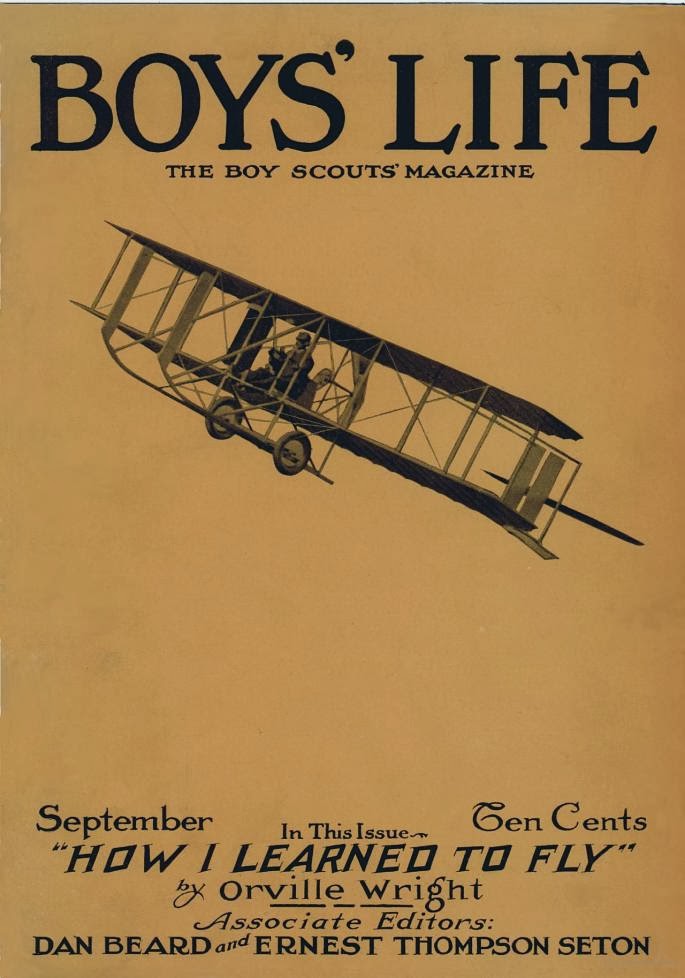
  
The cover of Boys' Life magazine Sept., 1914


 Historians and the public, who want to believe the Wrights were first to fly, have many excuses for  inconsistencies in witness's descriptions of` what happened at Kill Devil Hills, N.C.,  Dec.14-17, 1903--and indeed, later.  For examples: "Witnesses couldn't remember," or, "Their statements were made years after the facts."

This, of course, implies that the only statements we can rely on, according to these historians, are the statements of the Wrights, themselves. But what if the Wrights contradict themselves? Then even the historians have a dilemma.
Fast forward to the year 1914. It's important to note that Wilbur has died in 1912 of typhoid. Orville has gone into debt to buy back the stock of the Wright company. He plans to sell to another group of investors in Dayton. The  disgruntled stockholders of the original company are glad to sell, because they have found that Orville is unable, or refuses, to attend to business, and the Wright Company has been run into the ground. This despite the fact that in January, 1914, the company has paid for and won the final judgement against Glenn Curtiss in his last appeal against the Wright lawsuits.  Now Orville needs to collect money from all of his patent infringers. Which, apparently, according to the judges, includes every single aviator who dares to fly and make any money in the business.

But Orville wants out of the aviation business. What does he want? One clue is in an interview Orville gives to Boys' Life, the magazine of the Boy Scouts of America.  Among other glaring inconsistencies with the Wright brothers' previous narrations of their first "flights" is Orville's new story. He tells the Boy Scouts that he was the one who made the last and longest claimed flight on December 17. Orville has the byline. So we have to assume from his past history that Orville either "approves" of the story, or somehow doesn't know about the many discrepancies in it. This is difficult to believe and he has ample opportunity to correct it. To easily read the full story, please click the link to Boys' Life.

Boys' Life Magazine, 1914, which includes Orville's story of the "first flight"


In a previous entry, we established that the Wrights official statement about the claimed flights December 17, 1903, was as follows

1. Orville-- estimated 120 feet (100 feet beyond the track)--12 seconds

2. Wilbur--estimated 175 feet--13 seconds

3. Orville--estimated 200 feet--15 seconds

4. Wilbur --measured 852 feet--59 seconds

According to their joint story, Wilbur won a coin toss and made the first attempt on December 14, but he failed to fly and broke some parts of the plane. Then after repairs, it was Orville's turn to go first on the 17th. So, second that day was Wilbur's turn, third was Orville's, and the fourth and last was Wilbur's. It's important to note that when he was alive, it was Wilbur who was given credit for the only flight that is considered long enough by some, including Tom Crouch, to be considered "sustained," the flight of  852 feet. But then, of course, to be a flight, it would have had to be made from level ground like the Wrights said, not from a hill, assisted by gravity--as witnesses Daniels and Etheridge stated.       


Boys' Life Magazine, page 2
Boy's Life Magazine, page 3

Boys' Life, page 4, where Orville claims the longest flight of 1903 from his own brother

The circled section on the last page, page 4, of the Boys' Life article (above) by Orville Wright is transcribed below. Note, as stated, that Orville gives himself credit for the last and longest flight (57-59 seconds) that has been credited to Wilbur before. But Wilbur has died and can't correct his brother.
"The usual visitors did not come to watch us that day. Nobody imagined we would attempt a flight in such weather, for it was not only blowing hard, but it was also very cold. But just that fact coupled with the knowledge that winter and its gales would be on top of us almost any time now made us decide not to postpone the attempt any longer.

My brother climbed into the machine. The motor was started.  With a short dash down the runway the machine lifted into the air and was flying. It was only a flight of twelve seconds, and it was an uncertain wavy, creeping sort of a flight at best, but it was a real flight at last and not a glide.

Then it was my turn. I had learned a little from watching my brother, but I found the machine pointing upward and downward in jerky undulations. This erratic course was due in part to my utter lack of experience in controlling a flying machine and in part to a new system of controls we had adopted, whereby a slight touch accomplished what a hard jerk or tug made necessary in the past. Naturally, I overdid everything but I flew for about the same time my brother had.

 He tried it again the minute the men had carried it back to the runway, and added perhaps three or four seconds to the records we had just made. Then after a few secondary adjustments, I took my seat for the second time. By now I had learned something about the controls, and about how a machine acted during a sustained flight, and I managed to keep in the air for fifty-seven seconds.
I couldn't turn, of course--the hills wouldn't permit that--but I had no great difficult in handling it. When I came down I was eager to have another turn...."

 Now  compare this account with the account in Orville's diary as follows:

  " Thursday, Dec. 17 - When we got up a wind of between 20 and 25 miles was blowing from the north. We got the machine out early and put out signal for the men at the station. Before we were quite ready John T. Daniels, W.S. Dough, A. D. Esteridge, W.C. Brinkley of Manteo and Johnny Moore of Nag's Head arrived. After running the engine and propellors a few minutes to get them in working order, I got on the machine at 10:35 for the first trial. The wind, according to our anemometers at this time, was blowing a little over 20 miles (corrected) 27 miles according to the Government anemometer at Kitty Hawk. On slipping the rope the machine started off increasing in speed to probably 7 or 8 miles. The machine lifted from the truck just as it was entering on the fourth rail. Mr. Daniels took a picture just as it left the tracks. I found the control of the front rudder quite difficult on account of its being balanced too near the center and thus had a tendency to turn itself when stated so that the rudder was turned too far on one side and then too far on the other. As a result the machine would rise suddenly to about 10 ft. and then as suddenly, on turning the rudder, dart for the ground. A sudden dart when out about 100 feet from the end of the tracks ended the flight. Time about 12 seconds (not know exactly as watch was not promptly stopped). The lever for throwing off the engine was broken, and the skid under the rudder cracked. After repairs, at 20 min. after 11 o'clock Will made the second trial. The course was about like mine, up and down but a little longer over the ground though about the same time. Dist. not measured but about 175 ft. Wind speed not quite so strong. With the aid of the station men present, we picked the machine up and carried it back to the starting ways. At about 20 minutes till 12 o'clock I made the third trial. When out about the same distance as Will's, I met with a strong gust from the left which raised the left wing and sidled the machine off to the right in a lively manner. I immediately turned the rudder to bring the machine down and then worked the end control. Much to our surprise, on reaching the ground the left wing struck first, showing the lateral control of this machine much more effective than on any of our former ones. At the time of its sidling it raised 12 to 14 feet. At just 12 o'clock Will started on the fourth and last trip. The machine started off with its ups and downs as as it had before, but by the time he had gone over three or four hundred feet he had it under much better control, and was traveling on a fairly even course it proceeded in this manner till it reached a small hummock out about 800 feet from the starting ways, when it began its pitching again and suddenly darted into the ground. The front rudder frame was badly broken up, but the main frame scuffed none at all. The distance over the ground was 852 feet in 59 seconds."

http://www.libraries.wright.edu/special/wright_brothers/info_packet/images/primary_sources/1903_diaries_286287.jpg
Pages of Orville Wright's diary in which he details another version of the December 17, 1903 flights


Again, given that Orville Wright was a watchdog when it came to getting publications "right," it's a fair bet that he was aware of the multiple contradictions in the "Boys' Life" magazine to earlier statements both brothers made.   But can we prove Orville knew about the "errors"? See the next post

. To be continued.