Showing posts with label Paul Jackson. Show all posts

Tuesday, August 22, 2023

The Elephant in the Room


The Elephant in the Room

By Paul Jackson


Photograph courtesy of Bernard Dupont


Have you seen it yet? Not the one in the room that household guests politely refrain from mentioning, but the other elephant on Huffman Prairie, Dayton, Ohio, which aviation historians have feigned not to notice for the last century. It’s high time you were introduced to Jumbo. Paul Jackson will ‘do the honors’.

The story begins in what is now becoming familiar fashion – at least to regular readers of this blog – when a photograph taken by the Wright Brothers is found to show something different to what they wrote happened. A minor variation in this case is that the picture contains evidence of something significant happening that the Wrights passed-off as a minor hindrance, and over which generations of fawning historians have obligingly maintained the tradition of omertà.

Readily available for research is an image of the incident in question. It is downloadable in a range of resolutions from the Library of Congress at

https://www.loc.gov/item/2001696551

and also from that repository of Wright information and homage, the Wright State University

https://corescholar.libraries.wright.edu/special_ms1_photographs/70

For a caption the latter states:

Minor mishap of the 1904 Wright Flyer

The wreck of the Wright 1904 Flyer at the end of the 31st flight at Huffman Prairie outside Dayton, Ohio. Orville Wright was the pilot flying a total distance of 432 feet. The Flyer struck the ground with its front rudder, breaking the support.

All of which is perfectly correct—as far as it goes. The information is taken from Wilbur’s diary of flight testing, also available from the Library of Congress.

The date is show to be August 16, 1904. It says:

Aug 16th

[Flight attempt #] 31

160 ft track

Last 60ft in 2 sec

Wind 5 to 18 N.W.

First flight O.W.

Wind quartering about 45°.

Start good

Distance 432 ft

No anemometer [& time an assumation?]

Shot down and struck on front rudder, breaking off

By way of amplification and explanation:

(a) the Brothers were employing a 160-foot launch rail (compared with 60 feet as used at Kitty Hawk for what Truthinaviationhistory blog March 8, 2018 maintains was a downhill launch fraudulently claimed to have been made from level ground.)

(b) wind direction approximately 315° (from the northwest); speed appears to be in feet per second, equating to 3½ to 12 mph. Observations at previous tests gave anemometer readings in metres per second, accompanied by a second reading in feet.

(c) the wind of 315° was at 45° (“quartering”) to the direction of the launch track. This could mean a the track was laid out at 360° (due north) or 270° (due west), but comparison with the local geography – specifically the turnpike and adjacent railcar track (marked on the map below, and having a straight line of trees and telegraph poles) aligned 060/240° – indicates 270° to be the correct vector.

(d) “shot down” most certainly does not indicate the presence of hostile flak; “suddenly dived” might be a better phrase.

(e) “front rudder” is today called an “elevator” (ie, a horizontal control surface, even though placed at the front of the airplane by the Wright design and often referred to as a “canard elevator”).

We may now proceed to mark a map with all the known factors mentioned above. The basis of the map is one drawn by Orville Wright in 1928 and it conforms to the site as it is today (as checkable on Google Earth), it being preserved land within Wright-Patterson AFB.

Broken line is the intended westerly heading after take-off from the 160-foot rail. The rail was laid close to the (marked) hangar, but its exact starting point cannot be determined. However, the full photograph suggests it was pointing towards the three trees which Orville drew as marking the western boundary of Huffman’s land.

The full image. Huffman Prairie looking west from near the Wright hangar

One further item of reference material is required—a plan view of the 1904 Flyer:

So, we are now equipped to investigate the accident to the Flyer. A close-up of the scene reveals the following picture. (The figure is believed to be Charles Taylor, the Wright employee who built their engines.)

A close-up of the crashed 1904 flyer


Drawing of discernable features of the wrecked 1904 flyer (John Brown)

However, it does not look to be all of 432 feet away from the launching track, where the camera is. Could this be, perhaps, another one of these blatant exaggerations of flight distance—like the “Fourth flight photo” comprehensively disproven in an earlier (November 4, 2019) blog?

But hang on a minute; the curve back (visible in plan view) from the wingtips to the wing trailing edge establishes beyond any shadow of doubt that the Flyer is pointing towards its launching point. The airplane has turned through about 225° (almost two-thirds of a circle) over a distance of just 432 feet – a pretty wild maneuver, up there with the best of the air show “crazy fliers” acts – and during the last 118 years nobody has noticed that; or, at the very least, thought it worthy of remark.

Certainly, as stated in the flight-test diary, the Flyer has nosed into the ground, the front-mounted elevators taking the full impact. The twin (vertical) rear-mounted rudders sit high in the air after having “whiplashed” upward and forward,ripping through the diagonally-mounted fabric on theupper wing’s trailing edge, and coming to rest atopthe wing structure with their base tips pointing skywards. Knowing the wing chord (6 ft 6 in) and gap (6 ft 2 in), it can be calculated that the photograph shows the Flyer in a nose-down attitude of about 35°. Wilbur’s record of the flight testing program admits to a broken-off front elevator, but fails to mention that the entire tail section also detached itself from the wings and turned upside down as a consequence of the sudden arrival of the ground. Like Gaul, in the words of Julius Ceasar, the Flyer “est omnis divisa in partes tres.”

So, what happened? From the known weather on the day and the configuration of the Flyer on August 16, 1904, the following is likely.
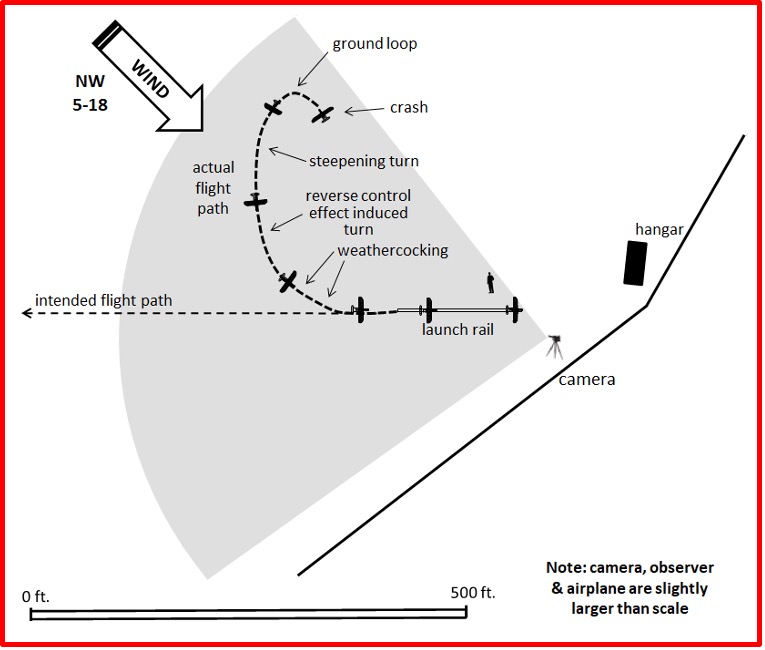
Flight 31 - the likely path (John Brown)

The aircraft began its take-off run on the 160-foot launch rail. It proceeded slowly at first, having a meager 16 horsepower installed, because the Wrights were still a few weeks away from commissioning the “falling weight” launch catapult conceived by Albert Merrill and recommended to them by Octave Chanute. Heading west, the Flyer had to contend with a fluctuating crosswind from the starboard (right) side.

On leaving the rail, but still low down and in “ground effect” (the lift of the lower wings being artificially and temporarily boosted by the air cushon “trapped” between them and the ground), the Flyer began to ‘weathercock’. In other words, the tailfins were caught by the ”quartering” wind and turned the airplane about its vertical axis to face the direction the wind was coming from.

Whether or not this was what the test plan called for is immaterial*; the turn into wind was inevitable unless the pilot pulled the right “levers” to counter the swing and maintain the take-off heading for the climbout. In a “normal” airplane, the pilot wishing to continue westward despite a northerly wind component would apply port (southerly, in this case) rudder to cancel-out the turning tendency, balancing that with counter-intuitive application of starboard (right) stick. The technique is known as “crossing the controls” or “applying top rudder” and is equally effective in lining up for a crosswind landing.

*The setup of the camera suggests a slight drift to the south was expected after take-off; not a swing to the north.

Thereby is dramatically revealed the disadvantage of the permanently linked rudder-to-same-side-aileron (or warping wingtip) system the Wrights copied from a December 1902 photograph and written disclosure by Gustave Whitehead in the Ohio-based journal, Aeronautical World. They patented it without acknowledgement; flew it; regularly crashed it (as here); eventually discarded it; and, cynically, still kept enforcing the patent even after they realised its dangers. (Furthermore, the Wrights’ 1906 patent specifically describes [page three, lines 78 to 87] the moveable, coordinated rudder as a means of maintaining a straight line in flight. Some “straight line!”)

As it was being involuntarily turned onto a northerly heading, the Flyer’s port wing would be on the outside of the turn and, thus, moving faster than the starboard wing. Lift varies proportionately to speed, so the port wing would rise and, as a result, the starboard wing would fall. With the whole airplane traveling slowly and still in ground effect to boot, there would be precious little daylight under the starboard wingtip and an urgent need to interrupt the cycle of inexorably unfolding events.

The straightness of the northerly track drawn on the diagram probably fails to do justice to the frantic control movements being attempted by Orville. If he made the usually correct move with the ailerons (warping tips) then the “reverse-control-effect” – which occurs at very low speeds and is known these days to all student pilots as part of their training curriculum – meant that the aileron movement normally intended to raise the wing created so much drag that it actually caused it to drop. A classic no-win situation.

At length, the starboard wingtip probably scraped the ground and spun the Flyer to the right in a semi-cartwheel ground-loop. Everything went quiet. Orville walked away and the three parts of the airplane were joined up again within the commendably short time of six days. So, does all this matter?


The result of the crash which ended Flight 31: Flyer broken into three parts, but the picture caption (above) describes this as a "minor mishap"

I believe it does. The airplane may have traveled 432 feet, but in a wildly fluctuating path not conforming to the pilot’s wishes; his control inputs; or, indeed his instinct for self-preservation. A traveled distance of, say, 1,432 feet** would have permitted a more sedate flight path between the known starting and finishing points, but 432 feet only allows for perilously rapid changes of direction, including the insane act of racking the 16 HP airplane into a tight turn immediately after leaving the ground. Evidently, on this flight – and, one suspects, others – Orville (and Wilbur) was just along for the ride. There was no control.

**The next time Orville flew the aircraft (sortie #33), by a staggering coincidence he added exactly 1,000 feet to the flight distance, making it 1,432

Yet the plaque beneath the Flyer in the Smithsonian Institute in Washington, DC, claims the Wright airplane was capable of “controlled and sustained” flight from Day One at Kitty Hawk. The pages of Wilbur’s diary are regarded by some historians as a faithful record of the development of the airplane, but it is becoming increasingly clear that this cannot be, in view of its downplaying of embarrassing occurrences.

More informative is MacFarland’s Papers of Wilbur and Orville Wright pages 469-472, from Wilbur’s February-March 1912 First Rebuttal Deposition in the 1911-1912 Herring-Curtiss legal case. This deposition discussed the 1904 flight testing and originally appeared in the court record of that case on its pages 519-521. Said Wilbur: "Usually the [1904] machine responded promptly when we applied the control for restoring lateral balance, but on a few occasions the machine did not respond promptly and the machine came to the ground in a somewhat tilted position"This is a remarkably underplayed statement by Wilbur, since Wright daily records indicate numerous crashes requiring repairs or replacement of wing spars, ribs, struts, skids, propellers, the engine, etc, and even minor injuries to themselves. As in this instance, they no doubt made the understatements to conceal their prolonged befuddlement at what was going on—despite repeated, incorrect fixes.

The suspicion must remain that the description of Flight 31 glosses over the unfortunate division of the Flyer into three parts, and passes the occurrence off as a minor “ding,” the culprit possibly being a downdraught while landing: AKA an “act of God.”

"'Tis but a scratch." (The Holy Grail; Monty Python)

For this and other reasons – not the least of which is the downward incline of the launch rail on December 17, 1903 (this blog, March 8, 2018) – it is the belief of this writer that while the Wrights usually told the truth, they often did not always tell the whole truth. Let none deny that they worked long and hard on “the problem of flight”—but it is clear that their record-keeping was more angled towards convincing historians that they flew under perfect control in December 1903 than to explaining to engineers how and why they only succeeded in doing so after September 1905.

A month after Flight 31, on September 20, 1904 (sortie #52) the Flyer is claimed to have demonstrated its navigational capabilities by flying a complete circle and overflying the start point, obediently following its pilot’s commands. See this blog for June 15, 2017 for detailed debunking of that assertion and view a written disclosure by key witness, Amos Root, that it crash-landed in an adjacent cornfield on that day, yet again out of control. That’s another date with the ground that the diary conveniently forgets to mention and current histories celebrate as a fully-controlled 360 degree turn—which, by any objective measure, it most certainly was not. Indeed, in late 1904, the Wrights were still devoting all their energies towards stopping the Flyer from uncommanded turning, and making it fly straight.

After a further year - in September 1905, and with significant modifications embodied - the Wright Flyer was at last showing the promise of achieving the “free, controlled and sustained” flight which was first documented in public during August 1908. On Flight 31, however, it was still rampaging like a rogue elephant—only mahout Orville was too ‘polite’ to mention it.

Tuesday, October 6, 2020

The Wright Propeller: Reply by Author-Historian, Paul Jackson, to Comment on "Propelled to Absurd Heights"


. Barnstorming aviatrice Katherine Stinson was the fourth woman in the U.S. to earn a pilot's license, on July 24, 1912, in a Wright Model B. The massive propeller tips are obvious

Comment

August 11, 2020 at 3:08 PM

by Anonymous Reader of blog post titled Propelled to Absurd Heights --Paul Jackson, Author 

"Arm chair quarterbacking, as usual...

The Wrights had decided that they would only use information that they have verified themselves, so crap in a book that they may not have fully read or understood, and in which they don't didn't have the hindsight of knowing to be correct is unfair. Further, you slander them for the crime of successfully building and piloting and airplane while heaping praise on a fellow who only made a prop. What a load of crap.

Signed, Anonymous"


 Reply to Anonymous

 Dear Anonymous:


You censure me for being what is termed wise after the event. This I refute, having merely drawn attention to the fact that the Wrights were “unwise after the event” — the event in question being  Hollands’ design and public announcement of an efficient propeller nearly two decades before the Wright Flyer.

I must assume that the opprobrium directed towards me is because I recognized, and drew attention to the importance of Holland’s previous invention of the modern propeller, whereas the Wrights didn’t. That’s not arm chair quarterbacking; I prefer to call it painstaking research.

The statement that “they would only use information that they [had] verified themselves” reinforces a view of the Wrights as arrogant and negligent. I am not sure you wanted to say that. Good inventors survey their whole field, evaluating all that others have previously done, and putting the best of everything into their new invention. But, like others, the Wrights had a blind spot for Hollands’ work. The point I make is that if Wilbur and Orville were half as smart as they are made out to be, they would have (a) diligently read-up on, and tested Hollands’ previously published ideas and (b) realized that he had an excellent design. They failed to do so, even after Chanute gave them Hollands’ findings in great detail.

In actuality – as other entries in this blog make clear – the Wright patent filed in 1903 contains the most gargantuan error it is possible to make on the fundamental subject of how a wing creates lift. They could not conceivably have “verified themselves” that 100 percent of wing lift comes from the underside (and not 67% from above), or proved by experiment that the cambered leading edge is only there to stop it flipping over backwards. This is aerodynamic illiteracy—as demonstrated by Giovanni Battista Venturi  in 1797. Clearly, the Wrights aped others while not understanding the elementary science of what they were copying.

“In a book that they may not have fully read or understood.” Is it being suggested, here, that some Englishman, two decades previously, could write an aeronautical treatise on the superiority of pointed-tip propellers which the Wrights (a) could not be bothered to read or (b) did not have the intelligence to understand, even if they had read it? Remember: these were the “geniuses” who “invented the airplane.”

“You slander them for the crime of successfully building and piloting and airplane,” I am told. Firstly, the written word is not slander, it is libel. Secondly, building an airplane is not a crime. Thirdly, stating that someone has performed an entirely legal and morally upright act cannot be libelous. Although somewhat baffled by the accusations, I plead not guilty.

The bottom line is that, even today, most medium/small airplanes employ a propeller invented in London in 1885 and not a propeller invented in Dayton in 1902. It looks like by pointing that out, I have caused (what you refer to as) the “cr*p” to hit the (Hollands’) fan

Sincerely,

Paul Jackson 

Retired Senior Editor of Jane's All the World's Aircraft

Sunday, December 28, 2014

Wright Brothers "Hijacked History."--by Historian Paul Jackson*

 "The Wrights are claimed to have solved the mysteries of flight," states Aviation Historian Paul Jackson; "still to be solved is the mystery of how they managed to stage the first air hijack -- of the history of aviation."

Jackson's statement is the conclusion of an exceptional essay (below),  just released, regarding early aviation history, as presented by contemporary historians. Today's views have been unduly influenced by the many questionable claims of the Wright brothers, Orville and Wilbur.

Paul Jackson is writing in his private capacity as an Aviation Historian, not his public persona as Senior Editor of one of the world's most prestigious aviation publications, "Jane's All the World's Aircraft." --ed.*

Rare "close-up" photograph of the Wright  "Flyer" (III) at Kill Devil Hills, 1908. Note the inclined track
 for take off, even in 1908. Without such assistance of wind and gravity, the Wrights used a catapult, no doubt because the "Flyer" was under powered.--ed.**

"Inflated to bursting point -- the Wrights’ claims

by Aviation Historian Paul Jackson

Almost two years ago, the present reassessment of Gustave Whitehead’s aeronautical achievements was publicly launched with editorial endorsement in Jane’s All the World’s Aircraft. This, Jane’s was pleased to do, because the methods of research and assessment of results accorded to time-honoured procedure which generations of its editors have attempted to implement. The period under consideration was prior to the establishment of the Jane’s annual and the study did not attempt any comparison between the respective achievements of the Wright Brothers and Whitehead -- indeed the Wrights were most emphatic that there was no connection between their endeavours.
    There the matter might have rested, save for the insistence of some that it would have been impossible for anyone to have flown an aeroplane before the Wrights showed them how it was done. On that premise, Whitehead’s claim would have to be dismissed without the courtesy of a hearing — an unjust and unscholarly reaction. For reasons which will become apparent, that insistence makes the early editions of Jane’s a vital witness to evaluation of the Wright-primacy claim.
    The origin of the present dispute is in the 1940s when the Smithsonian Museum acquired what is described as the original, 1903 Wright Flyer. Documents originally withheld, but now in the public domain, show that the Wright family and their friends and advisors were permitted to write the description board below the exhibit. Not surprisingly, this resulted in a gross exaggeration of the Brothers’ achievements, which hyperbole the Smithsonian has declined to correct. Thus, it finds itself condemned to defend the patently indefensible.
    The words specified in the once-secret agreement between the Smithsonian and the Wright family, bestowing indefinite loan of the Flyer, are: “By original scientific research the Wright Brothers discovered the principles of human flight. As inventors, builders, and flyers they further developed the aeroplane, taught man to fly, and opened the era of aviation.” This sweeping and absolute declaration leaves little room for Whitehead — or, indeed, for any of the other early pioneers mentioned in the aviation history books. However, both Wright claims may be demolished with nothing more potent than rational argument.
    Firstly, Orville and Wilbur wrote that they were inspired to begin their quest for flight by the descriptions and photographs which were being published in the early 1890s of Otto Lilienthal’s gliding achievements. Clearly, therefore, Lilienthal, or a predecessor, had discovered most of the fundamentals of aviation before the Wrights had given the slightest thought to the matter. Taking credit for one’s mentor’s invention is poor form.
    The second claim summons Jane’s as a ‘near witness’. Its first edition did not appear until 1909, but in this matter, the Wrights only effectively appeared on the scene in the previous year, 1908. This proximity assists in placing the Wrights’ contribution to flight in dispassionate perspective.
    It is seldom appreciated that the iconic Wright “1903 first flight” photograph was not produced until 1 September 1908. Before then, great efforts were made to keep the Flyer and its technicalities secret — with such success that some believed the brothers did not even exist. The first surreptitiously taken images from a photographer hiding in undergrowth only appeared in May 1908. It was at an air display in France in August 1908 that the Wrights revealed the Flyer to the public and allowed other, perhaps ‘rival’, aviators to see it close-up. The Wrights did not enlighten, offer to inform, or teach anybody anything until August 1908 — almost five years after they left Kitty Hawk.
    The name of the event at which they unveiled their invention is a clue to why they were too late with their supposed magnanimity. While the Wrights were secretly developing their Flyer, the Europeans had taught themselves to fly and had produced enough flying machines of various (including non-Wright) configurations to put together an air show. Creditably and without doubt, the Wrights had the best-performing aircraft at the show, but that is not quite the same as having the only aircraft.
    That several other pioneers produced flying machines in Europe without the Wrights’ assistance, and at about the same time, confounds those who would argue that “Only the Wrights could have invented the aeroplane.” Furthermore, having seen that others had the same ability at the same time, and could draw from a common fund of basic knowledge, it becomes logically impossible summarily to dismiss any other contemporary claimant to membership of that ‘flying club’ without proper investigation. If the Wrights had some special knowledge or technology denied to others, its acquisition was a pointless diversion from the task in hand, for the Europeans managed to get into the sky without it.
    Perhaps, it may be claimed, the Wrights’ appearance in France showed the Europeans the futility of their present path and converted them to the Wright way of building aeroplanes. There was, however, no change of direction. Sensation though the Flyer was in France, within a year it had been eclipsed by Bleriot’s cross-Chanel machine. The Bleriot XI’s configuration could not have been more different: It had the elevator at the rear (not the front); it was a monoplane (not a biplane); and the propeller was in the nose (not behind the wings). It was the aeroplane layout immediately recognisable today.
    Had the Flyer been so unique and sensational when it appeared out of ‘nowhere’ in August 1908, it would be reasonable to expect the first edition of Jane’s, a mere 15 months later, to have mentioned the fact that the book could not have existed without the Brothers’ immense contribution. Reviewing the world of aviation as it then stood, Fred Jane’s Foreword found it unnecessary to make any mention of the Wrights at all. Their aircraft (and its licence-built copies) is treated in the body of the book with no greater reverence than any other machine; and the longest entry in the book is that reserved for the Bleriot XI. The Wright was already yesterday’s aeroplane.
    The reason why Fred Jane launched his annual in 1909 was that there were so many different shapes of aircraft about that a guide was necessary. The claim that the world of aviation was, at the time, divided into (1) Wright types and (2) no-hopers does not survive scrutiny on several levels. Jane’s was summoned into existence precisely because the Wrights were not showing the world how an aircraft should be built and flown — or, at least, the whole world was not listening, and was getting the job done with alternative tools.
    It is undeniable that the Wright Flyer inspired many copies in 1909, and this is testimony to its flying qualities. But how strong was the Brothers’ influence on what real people were doing with real aeroplanes in real time?
    The pages of the 1909 Jane’s provide an answer. Analysing those aircraft which are illustrated by a photograph and/or drawing, it can be seen how many conform to the Wright canard-pusher-biplane configuration. There were 126 illustrated aircraft (excluding licensed versions) in the book, of which 42 employed the Wright layout — exactly a third. Nearly as many (38) were monoplanes, all but three with tractor propellers. Another 15 were biplanes with rear elevators and six were tractor triplanes with rear elevators. Discounting helicopters and kites, another 20, despite illustration, had layouts which are difficult to define.
     Perhaps, the Wrights’ 1908 ‘lessons’ were a little too recent for assimilation in 1909. Jumping four years to the 1913 Jane’s makes the position clearer, practical experiment having had ample opportunity to shape events. The matter may be summarised in the entry for the Wright Company, which had, even itself, abandoned the foreplane.
    The 1913 book illustrates 140 aircraft (with only one, additional indeterminate design), a mere 17 of which are to the Wright configuration. Its numbers were falling precipitately. The monoplane tractor (59) and biplane tractor (37), both with conventional tails, dominate. Pushers account for 25, most of them biplanes. Conclusively, therefore, the heyday of the Wright aeroplane design was in the year after it had been revealed — before the realisation dawned (reinforced by Bleriot) that those working on tractor designs with elevators at the rear were right all along.
    With hindsight, it can be seen that one ‘achievement’ of the Wrights was to misdirect a third of 1909’s aircraft programmes down a dead-end street. Back in the USA, they went on to exert such a malign influence on their homeland’s aviation that the country that invented the aeroplane was forced to buy British and French aircraft when it entered the First World War a decade later, because its own were so far behind in technology. The Wrights, their business partners and their lawyers were responsible for this squandered legacy.
    In the Foreword to the 1913 edition, Fred Jane credits the Wrights with being the first to fly an aeroplane. Curiously, this is an accolade he felt unable to bestow during the previous three years, when memories were fresher and the impact of 1908 far stronger. His endorsement was, of course, coincident with publication of Orville Wright’s self-flattering How We Invented The Airplane. Were ‘the victors’ already writing their own history? Certainly, the Wrights were the first aviators to write articles telling the world they were the first aviators.
    The Wright Flyer was in the limelight for fractionally less than a year in 1908-09. Its successor was no better than a dozen other contemporaries of different configurations and, in any case, Wilbur and Orville had lost interest in the aeroplane by then. There was nothing more from them. The Wrights are claimed to have solved the mysteries of flight; still to be solved is the mystery of how they managed to stage the first air hijack -- of the history of aviation."


 *Due to a series of miscommunications, it appears that I didn't have Senior Editor Paul Jackson's direct permission, as I thought, to publish this essay on my blog (even though the essay had been disseminated). Jackson didn't write this essay with the intention of having it published. In the spirit of true research, I feel I need to correct the record, as all honest and responsible researchers would do. My apologies to Paul Jackson and the readers of this blog.

** Photo and caption of the Wright "Flyer" in 1908 were added to this essay, not by writer Paul Jackson, but by "Truth in Aviation History" editors


"Truth in Aviation History" blog posts to be continued...