Showing posts with label wind tunnel. Show all posts

Sunday, February 20, 2022

The Wrong Wright Story Series #3: Tom Crouch's Wings


 The Wrong Wright Story Series #3:

Tom Crouch's Wings: A History of Aviation from Kites to the Space Age

By Joe Bullmer 


This is the third article in a five-part series presenting critiques of four of the most popular books and the most prominent TV documentary produced concerning the Wright brothers’ development of a manned, powered, controllable airplane.  Previous reviews discussed Fred Kelly’s 1943 book The Wright Brothers, A Biography, and Peter Jakab’s 1990 book Visions of a Flying Machine. 


This article discusses Tom Crouch’s book Wings: A History of Aviation from Kites to the Space Age published in 2003 by the Smithsonian, ISBN 0-393-32620-9.  This 725-page book undertakes the monumental task of covering all airplane development from da Vinci to the 21st century.  In this review, a couple of the book’s comments on 19th century developments are addressed, along with its description of the Wrights’ work leading to the final version of their Flyer III aircraft in October of 1905. 

These critiques are being done by an aircraft design and performance engineer and author of The WRight Story, The True Story of the Wright Brothers’ Contribution to Early Aviation. That book contradicts much of the content of the books and videos reviewed in this series.  The author of these reviews has also published four reviews of technical papers presented in The Wright Flyer-An Engineering Perspective, and two articles concerning the Wrights’ testing at Kitty Hawk, all of which have appeared at this site over the past couple years.

Some explanations appearing in previous articles are repeated in this one. A number of the same mistakes are made in this book, and each of these articles is intended to stand on its own. Forbearance is appreciated. Technically competent comments on these articles, or The WRight Story, are welcomed.

Chapter 1 

Page 33:  The author, without citing a reference, claims here that Sir George Cayley, in his 1809 article in Nicholson’s Journal of Natural Philisophy, Chemistry, and the Arts, identified an area of low pressure on the upper surface of a cambered wing.  Actually, Cayley mentioned “a slight vacuity immediately behind the point of separation ….under the anterior [forward] edge of the surface.”  He envisioned this air trapped under a thin cambered wing moving back under the wing and eventually being forced downward by the aft portion of the cambered wing, thus imparting the upward force on the wing.
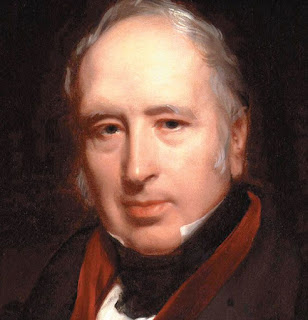

Sir George Cayley, aviation pioneer


On the same page, Crouch claims “Cayley had a lifelong preference for oars as propulsion.”  Actually, in spite of an early drawing showing oars, Cayley was well aware of the futility of such a scheme.  Over most of the second, third, and fourth decades of the 19th century, along with activities unrelated to aviation such as serving in Parliament, Cayley searched for a lightweight mechanical source of rotary power.  Unfortunately, by the middle of the 19th century studies of contained explosions of petro-chemicals were just beginning, so Cayley gave up his search for mechanical power and returned to gliders.

Page 36:  Orville Wright is quoted as saying “Henson, Stringfellow, and Marriott made no contributions to the art or science of aviation worth mentioning.”  But then Orville went on, “Every feature of Henson’s machine had been used or proposed previously.  His mere assemblage of old elements certainly did not constitute invention.”  I find it curious these statements were included in this otherwise complimentary book.  Except for their chain drive of propellers and interconnected rudder and warping, which soon had to be abandoned, Orville’s statement applies exactly to what he and his brother did.  In this one statement Orville’s judgement actually disqualifies himself and his brother as inventors.
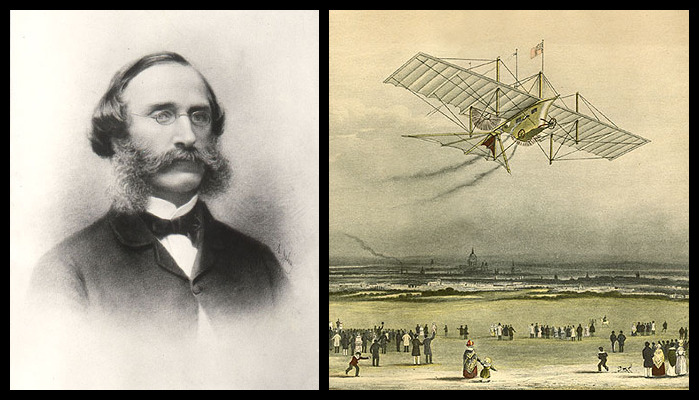
 

William Henson and his Aerial Steam Carriage

Page 43:  Here Hiram Maxim’s huge 1893 flying machine is described as having a 180 hp steam engine driving one 18-foot propeller.  In fact, numerous photos show that it had two such engines driving two 18-foot propellers.  This is important since the engines were to be independently throttled to yaw the vehicle which, in conjunction with dihedral on the outer wings, was intended to enable turning.  The vehicle was never flown freely and this scheme was never validated.  It also was the only prominent vehicle prior to the Wrights to feature an adjustable horizontal forward surface or canard (which was also never used).


Chapter 2

Page 65:  The author credits the Wrights with the “genius” that was “never more apparent” than in devising their wind tunnel balance that, through a mysterious “cascading chain of forces”, could indicate the relative magnitudes of the lift and drag forces on a miniature test section of a wing.  In fact, the device, indicating lift versus drag, was simply a flexible parallelogram that was explained to them by Dr. George Spratt during his visit to their Kitty Hawk test site during the summer of 1901.  Wilbur admitted this in an October 16th, 1909 letter to Dr. Spratt, and Orville admitted it in his sworn deposition for the 1920 Montgomery case.
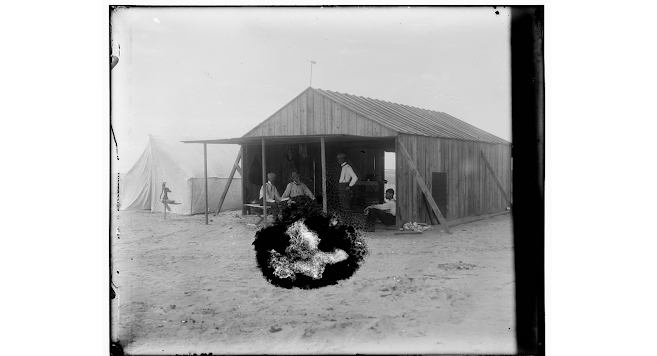
George Spratt's visit to Kitty Hawk, 1901

Wind blowing on the test wing would allow it to pull the parallelogram to an angle, the trigonometric tangent of which would yield the wing’s lift-to-drag ratio.  The Wrights modified this design to show the force on a test item versus the drag on flat plates perpendicular to the air flow.  It appears the whole idea of a wind tunnel was raised by Octave Chanute, Dr. Spratt, and Mr. Huffaker at Kitty Hawk during their visit in 1901.  There is no record of Orville or Wilbur even mentioning one before discussing it with Chanute and his cohorts that summer.  Chanute also showed them detailed photos of wind tunnel components during that visit.

On this same page the author claims the Wrights “discovered” the proper wing camber and aspect ratio with their wind tunnel.  What they discovered was that they had to abandon the totally inappropriate wing shapes they had been using for two years in an attempt to suppress the instability caused by their canard. Instead, to get sufficient lift they had to revert to the wing shapes that had been used previously by Lilienthal and many others.  They also admitted this in a November 24th, 1901 letter to Octave Chanute.
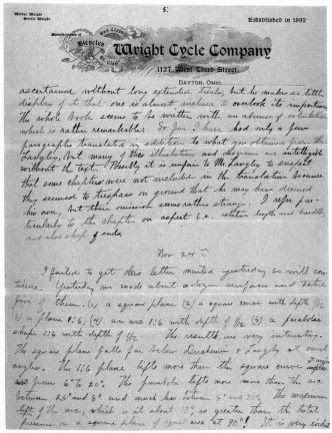
 

The Wrights' letter to Octave Chanute

Page 66:  Here it is claimed that the original 1902 glider “sport[ed] a rudder”.  In fact, it did not.  What it had were two fixed vertical stabilizers.  Only later, when it was found that this made the spin problems worse, was it changed to one moveable vertical rudder.  (A fixed aft surface is a stabilizer.  A moveable one is either a rudder or elevator.)  Deflection of that rudder kept the glider from spinning in when warping was used to correct an inadvertent roll.  (See The WRight Story, Chapter IV, or the discussion in the previous article concerning page 112 of the book “Visions of a Flying Machine” for more detail.)
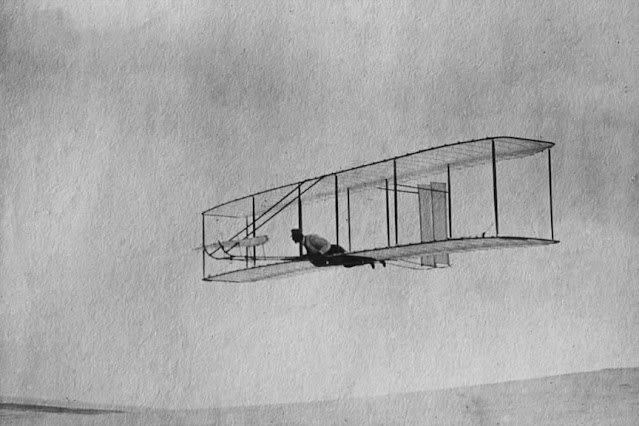
The 1902 Wright glider.

Page 67:  It is claimed that the Wrights’ first engine developed 12 hp “after it had been running for a few minutes.”  Actually, with only convective water cooling and a poor oiling system, the first engine would overheat within little more than two minutes of running.

Page 70:  The ludicrous statement attributed to Orville Wright by the Dayton Journal in 1923 is presented, claiming that the 1903 “Flyer” could have flown for 20 minutes at 1,000 feet of altitude.  Not only would the engine have overheated and seized in little more than a couple minutes, but the vehicle only had enough power to climb about half way out of ground effect, i.e., only about 15 feet above the ground.  And this vehicle could not be effectively controlled!  It’s disturbing that the National Air and Space Museum’s Curator for Aeronautics would write a book without being aware of any of this.

Page 81:  The device that allowed the Wrights to accomplish a successful test program at Huffman Prairie in 1904 and 1905, their catapult, is mentioned, again without any credit whatsoever being given to Octave Chanute for introducing the concept and basic design to the Wrights.  This suppression, or ignorance, of Chanute’s contributions to the Wright’s efforts (as listed in the discussion in the previous article in this series regarding page 84 of the Jakab book) is universal with Wright authors, as is lack of recognition of Chanute’s and Spratt’s contributions to their wind tunnel.  These, and other such omissions, are used to build the myth of the Wrights’ legendary “genius” enabling them to see the solution to every problem they encountered completely on their own.


Further along on page 81, disconnecting the rudder from the warping control to enable maneuvers is mentioned.  Their 1903 aircraft couldn’t lift itself off of the ground on its own, couldn’t climb even half way out of ground effect, damaged itself in half of its landings, was totally unstable, couldn’t be controlled or turned, and had an engine that couldn’t run more than two minutes.  But by October of 1905 they had developed an airplane that could be catapulted into the air with no headwind, could climb out of ground effect with an engine that could run over a half hour until fuel depletion, was much less unstable and could be kept under control, could be turned at will, and could be landed without damage.  In this book this is all attributed to “growing experience in the air”.  Nothing is mentioned of having had to lengthen and strengthen the airframe, completely change the balance of the machine, changing wing anhedral to dihedral, changing size, location, loading, and pivoting of the canard, devising aerodynamic turning aids, also creating cooling, an oiling system, and the fuel feed and mixing systems of the engine, and going through numerous propeller designs.  To say nothing of numerous crashes, busting up airframes, wings, propellers, even engines, along with a few minor injuries to themselves. 
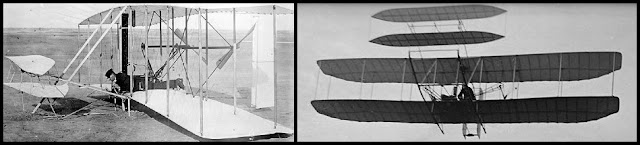
Left: Wilbur with the 1903 Wright Flyer; Right: the 1905 Wright Flyer III

I understand a book that purports to cover the entire evolution of flight up to the present day must take occasional shortcuts.  But two years of testing, modification, and results were just summarized here in one paragraph.

Page 124:  The erroneous and demeaning assertion is made that the Wrights “were far less interested in scientific theory or the fundamental physical principals underlying flight”.  The author of Visions made the same assertion in person, putting it more strongly by saying that “They were engineers, not scientists”.  Obviously, these history majors don’t appreciate what it takes to do competent professional aircraft design engineering.

The Wrights thought they understood the physical principles involved.  That is what distinguished them from most of their predecessors.  Unfortunately, in some cases they were wrong, including the physics principal most basic to their airplane: how a cambered wing generates lift.  This is verified by a number of their writings, including their major patent, giving erroneous explanations of lift.  And they paid dearly for that mistake, largely wasting their first two years of development work and testing, and adopting a configuration that soon put them behind their competition.
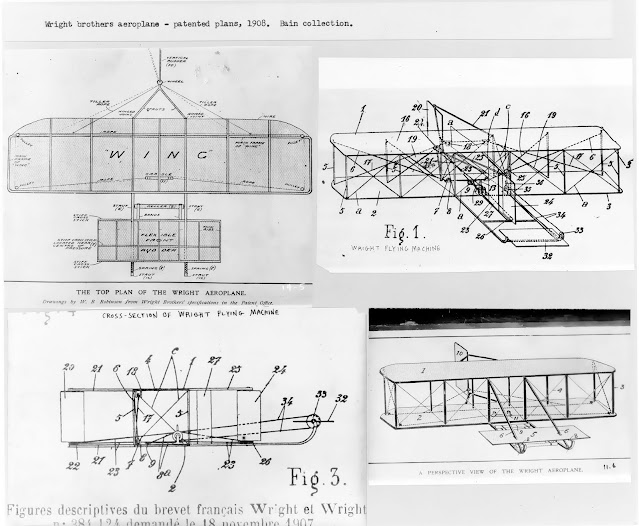
 

The Wright's 1908 patent designs

In the next two paragraphs the author goes even further into unfamiliar territory, claiming that engineers don’t agree on how a horizontal spinning cylinder generates lift.  He then goes on to settle this dispute for them by giving an explanation without mentioning boundary layers or stagnation points, key elements to understanding the phenomenon.  Perhaps the “engineers” advising him should go back to their first semester aerodynamic texts - if indeed any of them ever did study aerodynamics.

Pages 134 & 135:  The expenditures by various countries on aviation up to WWI are listed showing the United States ranked fourteenth behind such countries as Chile and Bulgaria.  But no mention is made of this largely being due to the Wrights stifling the development of aviation in the U.S. with their various patent suits and legal actions.  Much of this was enabled by judgements from the notoriously inept and corrupt New York District Judge John R. Hazel.  They were demanding 10 percent royalties from any airplane related incomes, including exhibitions, and 20 percent from their only real competitor, the Curtiss company.  Not only did the Wrights suppress aircraft production and development in the U.S., but even basic aviation research in academia was largely eliminated because of the resulting lack of industry interest or funding for such research.
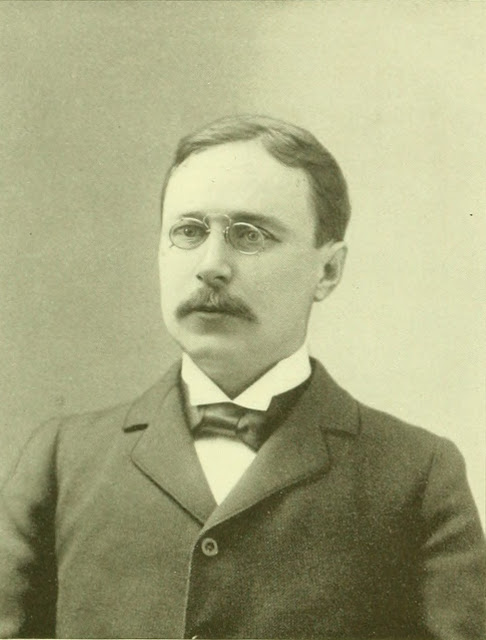
Judge John R. Hazel
 

How ironic that the very guys that, up through 1908, had put the U.S. first in the world in aircraft development, managed in the next five years to drag the U.S. down to a handful of uncompetitive unserviceable military airplanes while the major European nations each had hundreds of modern capable combat aircraft.  In fact, the original Wright Company only lasted five years, and the second, the Dayton Wright Company, only survived WWI by building a faulty British design under license.

Page 147:  For some unstated reason the Wrights’ commercial failure is primarily attributed by this author to their pusher propeller designs having the propellers located behind the wings.  This is odd since the success of everything from the Republic Seabee to the Convair B-36, the U.S.’s first true intercontinental bomber, would indicate otherwise.  Hundreds of B-36’s were produced, constituting, along with B-47’s, the U.S. strategic nuclear deterrent from the late 1940’s through the 1950’s.  Obviously its six huge pusher propellers were no impediment to its success.
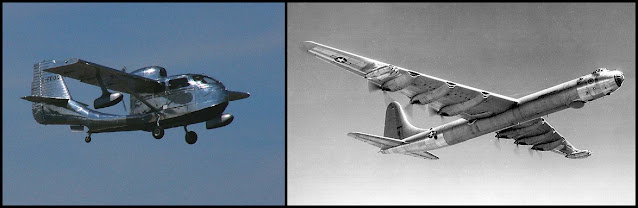
 

Republic Seavee and Convair B-36

No mention is made of early Wright aircraft’s lack of wheels complicating ground handling and requiring a rail and large catapult for launching, canard induced stability problems, warp-induced spins, no useful load capability, and a disproportionate share of crashes and crew deaths.  These deficiencies rendered Wright airplanes essentially useless for the military, the first large American user of aircraft.  By the time the Wrights eliminated these problems the rest of the aircraft industry had left them far behind.

Summary

Wings was an ambitious undertaking, attempting to cover over two centuries of aircraft development and production in 725 pages.  Over 100 contributors are listed in the Acknowledgments.  However, again, as with Visions, the last book reviewed, only very few of these contributors were ostensibly qualified to contribute any technical assistance, and these people apparently had woefully inadequate knowledge of the Wrights.

As would be expected in a Smithsonian book of this scope, many hundreds of notes were listed at the back.  However, only one of the comments made in this summary pertains to a passage in Wings supported by any of these references, that to an article in the Dayton Journal in 1923 quoting a universally discredited statement by Orville Wright.

It appears this author relied heavily upon the advice of the author of Visions of a Flying Machine since a number of the same exaggerations and errors appear in both books.  Also familiar is the technique of replacing research with assumptions and opinions.  One would expect more on such an important subject from the highest level of the Smithsonian’s National Air and Space Museum.

Any book of this scope would, of necessity, omit much detail.  But that does not excuse the inclusion of incorrect information, particularly on what is universally considered the origin of the entire technology and industry.  This is particularly unfortunate since so many “aviation historians” have relied on this material as the basis for their work.


Sunday, September 19, 2021

The Wrong Wright Story Series #2: Visions of a Flying Machine (Part II)

The Wrong Wright Story Series #2

Peter Jakab's Visions of a Flying Machine (Part II)

By Joe Bullmer

Introduction to Part II

The previous article in Truth in Aviation History discussed the first four chapters of the book Visions of a Flying Machine by Peter Jakab. In this article, the subsequent six chapters of that book are critiqued. The article begins with a listing of the largely overlooked, but well documented and vital contributions to the Wrights' efforts made by Octave Chanute. The damage done to the historical record by Visions is summarized at the end of this article.

Left: Peter Jakab’s Visions of a Flying Machine. Right: The Wrights’ mentor, Octave Chanute.
 
 Chapter 5: "Riding the Winds"

Page 84: The Wrights’ relationship with Octave Chanute is discussed by saying that “Chanute provided the Wrights with little genuine technical assistance and few if any useful theoretical ideas.” This egregious falsehood is exactly opposite of the truth. According to records of their correspondence, Chanute provided the Wrights with, or alerted them to:

  • His 1894 book that was the basis for their study of earlier works.
  • Realizing the biggest problem remaining to be solved was control.
  • The need to master control with gliders before adding power.
  • Trussed biplane wing construction.
  • First testing gliders unmanned with tethering lines.
  • The best gliding areas are the coasts of Georgia and the Carolinas.
  • His cohorts (Huffaker and Spratt) who showed the Wrights the reversal of the center of lift’s movement.
  • Doing tests with a wind tunnel to determine better wing shapes.
  • Photos of wind tunnels and the design of their lift balance.
  • The basic design of a falling weight catapult enabling testing near Dayton and flying for the next six years.

In fact, it is evident that without these inputs the Wrights may well not have succeeded. If they did it would have taken them far longer, which may well have denied them the reputation of being the first to accomplish powered, manned flight.


 Page 110: The claim is made that the wing tests at Kitty Hawk “confirmed their earlier assumption regarding the reversal of the center of pressure [lift].” As previously discussed in relation to page 65, the Wrights did not have an “earlier assumption regarding the reversal of the center of pressure”. They admitted that the Kitty Hawk tests suggested to them by Huffaker and Spratt in 1901 showing the reversal of center of pressure movement came as a complete surprise to them.
Left: Dr. George Spratt (photo from the Harold E. Morehouse Flying Pioneers Biographies collection in the NASA archives); Right: Edward Huffaker

Page 112: Here, the author’s shoddy research has led countless subsequent authors and historians into an unintended error. A discussion on the Wrights’ problem with wing warping drag is opened by saying “Wilbur took the next step and attempted to make an intentional turn with wing warping.” In fact, the Wrights, particularly Orville in his 1920 deposition, made it perfectly clear that they were not attempting turns at Kitty Hawk, but rather were simply trying to maintain heading and avoid spins while correcting inadvertent banking when they ran into the problem.

They had put anhedral or droop into their wings to facilitate traversing a hill without getting rolled and blown sideways into it. Unfortunately anhedral made their gliders unstable in roll since the higher wing would develop more lift than the low one. But when they used warping to bring the glider back level, the downward warp on the low wing gave that wing substantially more drag causing it to drag back and slow down so much that it actually lost lift. This made the vehicle spin and roll further into the bank rather than level out.

Describing this problem in his 1920 deposition, Orville testified that “Sometimes in warping the wings to restore lateral balance…” In another reference to roll control he stated “When the wings were warped in an attempt to recover lateral balance…” On page three of their 1906 patent, it says “…owing to various conditions of wind pressure and other causes, the body of the machine is apt to become unbalanced laterally…. The provision we have just described [wing warping with coordinated rudder] enables the operator to meet this difficulty and to preserve the lateral balance of the machine.” Nowhere does their 1906 patent address turning.

The Wrights also describe their glider spinning into the lower lagging wing and auguring it into the sand. The Wrights referred to this as “well digging”. Had they been trying to turn, the vehicle would have slipped straight toward the other side, which it didn’t.

Actually, with the rudder mechanically connected to the wing warping, and only deflecting enough to keep the 1902 vehicle going straight, both it and the 1903 Flyer couldn’t turn. In fact, the Wrights were only able to make turns after they disconnected the rudder from warping in 1905. However this error in the book, along with laziness and/or lack of understanding by subsequent authors and historians, has perpetrated to this day the myth of the Wrights practicing intentional turns at Kitty Hawk.

Chapter 6: "Seeking Answers: The Wrights Build a Wind Tunnel" 

A 1949 reproduction of the Wright Wind Tunnel by the National Cash Register company

Page 119: This chapter launches into a two-chapter discussion of what was supposedly wrong with Lilienthal’s lift data to cause the Wrights to have lifting problems in 1900 and 1901. Right away it erroneously states that they used Lilienthal’s incorrect value of Smeaton’s coefficient for both of these vehicles. This is obviously wrong since wing area is proportional to Smeaton’s, and the ’01 vehicle had twice the wing area of the ’00.

This two-chapter discussion of what was “wrong” with Lilienthal’s data and how the Wrights “corrected” it with their wind tunnel, includes a whole series of falsehoods that have been repeated ad infinitum by authors and “experts” for over 30 years. The first blunder is saying that Lilienthal used Smeaton’s coefficient to calculate his lift coefficients from the equation

This is absolutely wrong since, as evident in Lilienthal’s book, Birdflight as the Basis of Aviation, he simply compared the lift on his wing sections at various angles of attack to their drag at 90 degrees. Since, at that time, the drag coefficient of any plate at 90 degrees was taken to be 1.0, the ratio of the pressures was the lift coefficient directly.

Lilienthal's glider. Photo from britannica.com

The next blunder was spending pages on what was wrong with the whirling arm device used back then by many experimenters to calculate lifting data. As its name implies, a long arm went round and round with a test section on its tip. Obviously the test section was (without a breeze) continually passing through its own wake of turbulent air which could cause errors. Lilienthal did use a 25-foot diameter whirling arm to calculate some of his data. However he also did tests in steady natural wind with no turbulence. Both of these data were plotted as “Plates” at the back of Lilienthal’s book.

Lilienthal's whirling arm device.

Later Lilienthal took the tabular data of lift coefficients for one of these plots and published it in James Means’ Aeronautical Annual. Anyone willing to go through the trouble to compare all of the table entries to the corresponding points on the plots in the back of Lilienthal’s book can see that the tabular data, which is all the Wrights had, exactly corresponds only to the points on the plot for a natural steady straight smooth wind. So, contrary to assertions in the subject book, the data the Wrights used had nothing to do with a whirling arm, or Smeaton’s coefficient.
James Means' Aeronautical Annual

Along with a lengthy discussion of the Wrights’ wind tunnel (we’ll get to that in a moment) the author spends a substantial part of the next 30 pages trying to say what could cause errors in Lilienthal’s data without actually determining anything. He uses the terms “could have”, “might”, “if”, “could be misleading”, “problems”, and “may have’s” without ever reaching a conclusion. The author’s task is made worthless by the fact that the Wrights admitted in a November 24, 1901 addition to a letter to Chanute (originally dated November 22, 1901) that the errors causing poor lift were theirs, not Lilienthal’s, and that there was nothing really wrong with Lilienthal’s data.


Page 124: Near the bottom of this page we are told that “the Wrights’ wind tunnel work best demonstrates their brilliance as engineers”. No mention is made of the fact that the idea and design of the tunnel was discussed with the Wrights by Chanute and his cohorts, Huffaker and Spratt, at Kitty Hawk. In fact, the subject was probably brought up by the Wrights’ guests since there is no mention anywhere of a tunnel by either of the brothers before then. As previously mentioned, during the summer of 1901, Chanute showed the Wrights photos of existing wind tunnels, and Spratt gave them the design of their “ingenious” and “inventive” lift balance with which to take test measurements.
 
Visitors to Kitty Hawk: l-r Octave Chanute, Orville Wright, Edward C. Huffaker, and Wilbur Wright.

In a letter to Chanute from October 16th, 1901, Wilbur refers to the photos, and in a letter to Dr. Spratt from October 16th, 1909, he discussed Spratt’s lift balance and claims he will be sure to give Spratt his due credit for the idea in the future. Orville also mentioned that the lift balance was Spratt’s idea in his sworn deposition for the 1920 Montgomery court case.

Throughout just this one chapter he lavishes gushing adjectives and phrases on the Wrights, including “imaginative, clever, conceptualizing, genius, marvels, ingenious, incredibly impressive, amazing, sophistication, inventive, visualizing, think through a problem clearly, and technical skill.” He even, on page 135, gives the Wrights credit for devising the scheme of calculating lift coefficients from force ratios and thus avoiding the use of the controversial Smeaton’s coefficient, not realizing, as was just discussed, that is exactly how Lilienthal did it ten years earlier.

Page 144: Here the erroneous claim that Lilienthal’s lift coefficients were wrong is repeated. A blunder trifecta is completed by repeating his claims that Lilienthal used a whirling arm and an incorrect Smeaton’s coefficient to generate the lift coefficients the Wrights used

Page 146: A plot of the Lilienthal lift coefficients versus angle of attack is presented along with the Wright data for a similar wing. This clearly shows that the data are basically coincident at the angles used in flight, and that Lilienthal’s data are more consistent than are the Wrights’ data. Not questioning the validity of his previous claims, the author merely attributes this data agreement to coincidence.

Pages 147 & 148: Here the author goes completely off the rails again saying that “Lilienthal’s….table had an even greater drawback” in that it could only be used for one wing shape! This statement is nothing short of bizarre. That is the purpose of lift coefficients, to express the different performances of differently shaped wings of the same size at the same flight conditions. This statement is exactly equivalent to saying that Volkswagen wheels are no good since they won’t work on a dump truck, or the recipe book has a drawback in that it calls for different temperatures or baking times for different dishes.

Page 149: While he’s out of his element, the author calls the fact that Lilienthal’s lift coefficient data can only be used for one given airfoil or wing shape a “stumbling block” and a “pitfall”. But farther down the page he magnanimously forgives Lilienthal’s “mistakes” because of all his “contributions to the advancement of aeronautics.”

Page 150: Here, after having sung their praises in previous chapters, the author finally acknowledges that the 1900 and 1901 Wright gliders had inadequate lift.

Page 152: The subject of induced drag is raised and the author ascribes the improved efficiency of the 1902 wings to an improved camber or curvature shape. Although the Wrights’ camber change probably changed lift coefficient somewhat, the vast majority of the reduction in induced drag was due to their more than doubling the aspect ratio from 1901 to 1902.

Page 153: The Wrights’ discovery of the significance of aspect ratio is mentioned here with no recognition that this was known by George Cayley a century earlier, and by many aviators in between. The Wrights could have learned this, years earlier, simply by reading. He also fails to mention that, along with changing their wing camber shape to much like that used by their more successful predecessors, they also changed their wing’s aspect ratio from 3.1 to 6.5, exactly the value used by Lilienthal on his test wings.

Sir George Cayley

Page 156: Reprinted here is Orville’s boast about how their predecessors were so ignorant of camber that they all used highly inefficient shapes and none had developed good data. Orville wrote “we possessed in 1902 more data on cambered surfaces, a hundred times over, than all of our predecessors put together.” Unfortunately this author, and apparently all others, are unaware that although the Wrights may have had more data that any others, they totally failed to understand the basic aerodynamic principal that caused their data

But their predecessors, Augustus Herring, Horatio Phillips, and Otto Lilienthal, did understand lift. They all knew that the primary cause of lift on a cambered wing was lowered pressures on its upper surface. The Wrights thought it was all due to pressure on the bottom of a wing that met the flow at a positive angle. In fact, that’s why they always used the term “center of pressure” (on the bottom of the wing) instead of center of lift (on the top surface).

In their 1906 patent they stated that their aircraft were “…supported in the air by reason of the contact between the air and the under surface of one or more aeroplanes [wings], the contact surface being presented at a small angle of incidence to the air.” They thought the only purpose of camber was to allow the wind to impact the forward upper surface of the wing to keep it from flipping over backwards. They held this erroneous belief for years after creating their powered airplanes.

Chapter 8: "'We Now Hold All Records!'"

Page 175: The author claims that the moveable rudder “provide[s] another instance of the presence of visual thinking in the Wrights’ inventive method.” Unfortunately their “visual thinking” did not recognize the problem of warp induced yaw beforehand, and that the fixed rudder, which they tried first, would make the problem worse.

Chapter 9: "The Dream Fulfilled"

Page 184: Yet another example of careless research is the claim that, in the Wrights’ first patent granted in 1906 “No mention of power is made in the claims.” In fact on page 1, lines 12-15, the patent states “….[the] aeroplanes [wings] are moved through the air edgewise at a small angle of incidence either by theapplication of mechanical power or by the utilization of the force of gravity.”

Page 186: Another try at belittling Octave Chanute is made by claiming that his statement that three-axis control was “ancient and well known” showed “almost unfathomable ignorance on the part of Chanute.” This claim actually shows “unfathomable ignorance” of the history of flight by a Director of the Smithsonian’s National Air and Space Museum. The concept of three-axis control was evident in a few glider concepts and vehicles, including Professor John Montgomery’s in the 1880s and going as far back as Le Bris’ 1857 glider which had wing warping and moveable horizontal and vertical tail surfaces. Moreover, the argument can be made that the Wrights didn’t actually have three-axis control until 1905 since their earlier vehicles all had vertical rudders only as an adjunct to wing warping to make the roll control work as intended. Those vehicles could only erratically control pitch and recover from inadvertent rolls, but could not intentionally execute turns.

The 1857 flight patent by Jean-Marie Le Bris

Page 189: We are told how Wilbur and Orville “cleverly used their tables…and lift and drag equations to determine the ….power requirements for the aircraft.” Unfortunately they were only “clever” enough to do it for level ground skimming flight. They did not heed warnings going all the way back to Cayley a century earlier, that an airplane would need additional power for taking off and climbing away from the ground. As a result, their aircraft could not “raise itself by its own power into the air” as they so proudly claimed in their post-1903 statements. In fact, their airplanes could not climb out of ground effect until 1905, and could not achieve flight without the help of strong headwinds or a catapult until late 1910, long after numerous other aircraft were routinely doing so.

Pages 194-198: On these pages the Wrights are lauded for making the “intellectual leap” that a propeller was just a wing moving in a spiral pattern and thus needed to be made up of cambered sections twisted as they went out from the hub to account for their increasing speeds through the air. Actually, this exact concept was presented to the Aeronautical Society of Great Britain in 1885 by Sidney Hollands and published in the U.S. by Chanute in February, 1893. (See the previous article Propelled to Absurd Heights by Paul Jackson in the January 26th, 2020 posting of this blog.)

 
Sidney Hollands, pioneer of the modern propeller

In fact, Hollands went the Wrights one better by also pointing out that the blades should be tapered as they progressed out from the hub to minimize bending loads and aerodynamic tip losses. It was primarily the increasing blade widths of the Wrights’ propellers that limited their efficiencies to around 65 percent. It may well also be this excessive tip loading that contributed to one splitting and causing Orville to crash during a 1908 demonstration at Ft Myer, killing Lt. Tom Selfridge and braking Orville’s back.

Page 206: The assertion is made that the Wrights use of a 60-foot launching rail would “make it clear that the [1903] takeoff[s] had been unassisted, allaying any possible doubts that the Flyer had made a true flight.” However the author says nothing about the fact that at Kitty Hawk, on the morning of December 17th, 1903, the 27 mph headwind with gusts even higher, supplied at least 90 percent of the airspeed, and over 80 percent of the lift required to get the Flyer into the air. It was almost flying sitting still without the engine and propellers turning. In fact, later that day the unattended vehicle did just that, the wind raising it up and rolling it over, destroying it. It would seem this wind constituted an essential assist and could raise, in Jakab’s words, “doubts that the Flyer had made a true flight.”

Chapter 10: "The Meaning of Invention"

Page 213: Although previous chapters lauded the Wrights’ “three-axis control” as enabling their 1902 glider to make turns, here that is directly contradicted by stating that “Before marketing their invention was possible, they would have to be able to make turns”. The author correctly points out that this was the purpose of their testing in 1904 and 1905 at Huffman Prairie, seemingly oblivious to the fact that he has made yet another contradiction within his own book.

l to r: 1902 Wright glider, 1903 Wright flyer, 1905 Wright flyer

Page 217: After spending the whole book describing the Wrights’ fabulously inventive genius, the book winds up by saying on the last page that “with the exception of the propellers, there was nothing fundamentally original about the way in which the 1903 machine was designed”. But as a last treat, two paragraphs down the author yet again demonstrates a somewhat schizophrenic style by following that statement with “they invented a fundamentally new technology.”


Summary

At this point I am somewhat at a loss for words to conclude this review. Not only is this the most inaccurate and confused book on the Wrights I have ever read, it is also possibly the most inaccurate record of technological history. And it was written by an Associate Director of the World’s premier aviation museum along with the help of some supposedly qualified technical contributors. Possibly some pressing deadline was imposed on the book preventing any real research. Or perhaps the intent was to do America a service by deifying two of its favorite sons. But still, these would not explain the numerous contradictions.

The real shame is that so many of the errors in this book have become part of the accepted historical record, and been repeated many times over, for decades, in subsequent books and media. This book seems to be yet another example of authority trumping truth.

--Joe Bullmer

Wednesday, July 9, 2014

Dr. George Spratt--A Letter and a Lost Friend


One More Chapter on the Wrights Invented What?

"After having for twenty years capitalized upon this as your own work I do not see how you can give a correct account of this without bringing yourselves into open censure"--Dr. George Spratt to Orville Wright, 1922, on the development of the Wright flyer.

Dr. Spratt as an Inventor

A control wing aircraft built in 1939 by Dr. George Spratt's son, using the doctor's designs


The concepts behind Dr. Spratt's amazing control wing invention were beyond Wilbur Wright's understanding, as is clearly revealed in his letters to the doctor. Contrary to what we are taught, it was Spratt's ideas that the Wrights used to build their wind tunnel. Link here to great Youtube videos of Spratt's control wing in flight and a few derivations of his invention.

Dr. Spratt's Relationship with the Wrights

An early friend of the Wright brothers, Dr. George Spratt wrote his last letter to Orville Wright in 1922. See it below. Was it it an expression of sour grapes or a statement of the betrayal of a once loyal friend? You be the judge. I've emphasized some of the copy, so it's obvious where I stand. As you read today's Wright "history," as it was carefully pruned and shaped by the Wrights, look for the explanations and rationalizations they write for primary documents, such as this letter. It would seem that Dr. Spratt was wrong when he said "It makes little difference what you write, history writes itself."

Dr. George Spratt was another of the pioneer aviators, who like Edward Huffaker, came to Kitty Hawk in 1901 to help the Wrights, at the request of  Octave Chanute. Like Huffaker and Chanute, Spratt freely provided the Wrights with suggestions and help.

Wilbur publicly admitted early on that both Spratt and Huffaker had educated him on the movement and reversal of the center of pressure as a plane changes its angle of attack. But neither Wilbur nor  Orville repeated that admission any time later.*

 In 1901 at Kitty Hawk, the Wrights had warmed to Spratt, unlike Huffaker (see previous blog post), and they invited him back in 1902 and 1903. A lively correspondence sprang up between Wilbur and the doctor and information was exchanged. However, when the Wrights began their insults to early aviation by suing anyone they thought infringed on their 1906 glider patent, Spratt's response began to cool. Further, Spratt requested recognition for his important contributions to the Wrights' wind tunnel tests and later asked for help in building his "control wing" plane.Wilbur wrote back that it was enough that he had sent Spratt tables from the wind tunnel tests and shared information of his own. They were square and he owed him nothing.(What?)  It is now established that the Wrights wanted the world to believe that their research was theirs and theirs alone--a myth that came to prevail..

Eventually, the friendship with the Wright brothers soured to the point that Spratt no longer would answer their letters.

 Dr. Spratt's Stinging Last Letter to Orville Wright

Much later, in 1922, Orville Wright wrote Spratt for copies of the brothers' letters they had written to him over the years-- (he also tried to acquire Wilbur's letters to Octave Chanute that were in the possession of his daughters after his death.) Orville was apparently compiling his version of the early history of aviation.

 The following letter is Dr. Spratt's response to Orville's request in its entirety. Those who are interested in truth in aviation history need to read this letter carefully:

Wilbur and Orville Wright Papers, Manuscript Division, Library of Congress, Washington, D.C.**


Dr George Spratt's last letter to Orville Wright. Emphasis is mine.

 For much, much more about the Spratt/Wright saga and Dr. Spratt's contributions to the Wright flyers, go to this link: http://www.gustave-whitehead.com/history-of-whitehead-critics/wei%C3%9Fkopf-verkannter-erfinder-oder-scharlatan-gibbs-smith-luft-raumfahrt-jan-1982-pp-8/don-paulson-on-wright-spratt/

* I have been since informed that Orville admitted some twenty years later Spratt's and Huffaker's educating the Wrights about the movement of the center of pressure. I will have to research this.

**This letter can be found in "The Wilbur and Orville Wright Papers" under Series, General Correspondence, Items 214, Images 16 and 17.

To be continued...

Wednesday, July 2, 2014

The Wrights Discovered What? Another Chapter


Was the Wrights' "original" research original?

The aspect ratio of the wing

“I do not feel obliged to believe that the same God who has endowed us with sense, reason, and intellect has intended us to forgo their use.”-Galileo Galilei 

"There are no secrets." Glenn Hammond Curtiss


Gull in flight. Credit NOAA

Wilbur Wright became seriously interested in aeronautics after Otto Lilienthal, the great German aviation pioneer, lost control of his glider and died from the crash in 1896. Lilienthal's glider experiments had brought him just to the point, it's said, that he planned to attempt manned, powered flight.

Otto Lilienthal in flight. Credit: National Air and Space Museum Archives, Smithsonian Institution
Apparently, Wilbur saw the opportunity to continue where Lilienthal left off. Accordingly, he stated his intention, when he wrote to the Smithsonian for information in 1899, to take the level of aviation at that point in time and "add his mite." To read aviation history, however, and the court battles the Wrights instigated in 1909 to establish their intended monopoly, the Wrights pioneered the "secret of 
flight," starting when Wilbur began his aeronautical investigations.

 Research in aviation history is difficult at the very least. It's full of complicated aeronautical concepts and mathematical formulas, and it's a whole lot easier to accept the Wright version of history. "First to fly, did all their own research with their wind tunnel, Kitty Hawk, 1903, geniuses, etc"--fairly easy to learn sound bites. Advertisers and politicians use sound bites all the time if they want to sell you something, or worse, to make you believe something that might not be totally true. By the time Wright biographies exploded in vast numbers, most people believed that the Wrights' sound bite version was gospel, anyway. In fact, maybe it was the sound bite that the Wrights discovered! It certainly wasn't the "secret(s) of flight." The corrected Smeaton's coefficient, the function of the aspect ratio of the wing, and the travel forward and reversal of the center of pressure were studies  pioneered before the Wrights by Professor Samuel Pierpont Langley. See John David Anderson, Jr.*

The aspect ratio of the wing is the length of the wing in proportion to the width. Professor Langley's experiments published in 1891 showed that a longer narrower wing ( high aspect ratio), as opposed to a shorter, wider wing (low aspect ratio)' is more efficient in lift. The long, narrow gull wing pictured below, lower right, is designed by nature so that the bird can efficiently soar and glide long distances.


When Wilbur, who determined to learn aviation, wrote the Smithsonian in 1899 for information about the state of the art; the Institution promptly sent pamphlets and recommended books on the current published knowledge in aeronautical research. Among them were two publications by Professor Langley and one by Edward Chalmers Huffaker. See letter and notes below.


From the Library of Congress digital collection


Notes on the back of letter "copy" above. From the LOC digital files

In the "copy" of his thank you letter, above, we can see that Wilbur orders Professor Samuel Langley's 1891 publication called "Experiments in Aerodynamics" for one dollar. I have provided you with the link that will take you to Langley's publication, complete and digitized online, which is a primary source of Langley's early experiments,  Here we have, fully documented, Professor Langley's experiments and conclusions on the aspect ratio of the wing in chapter V, page 26, "The Plane Dropper."--These are the plane dropping tests that John David Anderson refers to on pages 171-173 of "A History of Aerodynamics." *  Selected quotations from Anderson's book as follows:.
   "Another novel device designed by Langley was his plane dropping apparatus....The most important finding from Langley's plane-dropping tests was that a wing with a high aspect ratio would produce more lift than a wing with a low aspect ratio..."Anderson page 171
 "Wenham had preceded Langley in appreciating the aerodynamic efficiency of high-aspect ratio wings, but Langley was the first to produce an organized set of experimental data clearly showing the superiority of such wings." Anderson page 172
         " An irrefutable demonstration that high-aspect ratio wings were superior to low-aspect ratio wings, and by approximately how much, was good enough for Langley, and that determination was one of his major contributions to applied aerodynamics." Anderson page 173
But in the 1943 Fred Kelly biography "The Wright Brothers,"** authorized by Orville Wright, we have a description of some of the discoveries the brothers claimed they made from their wind tunnel tests in 1901--ten years after the publication of Langley's report. Among them, see below:

On page 76 from "The Wright Brothers" by Fred Kelly***


The trials of the 1902 glider p 79 of The Wright Brothers by Kelly
Success of the 1902 glider, Kelly p. 80


With changes to their 1902 glider, particularly the aspect ratio, we see that the Wrights achieved more successful flights than in the disappointing trials of 1901. As noted above, they attributed their success to their wind tunnel tests and their discovery that the higher aspect ratio would provide more lift.

However, at least one of the aviation pioneers who was at Kitty Hawk in 1901 knew better. It was Edward Chalmers Huffaker.The Wrights ignored or downplayed input by Edward Huffaker and Dr.George Spratt in 1901 whereby they very likely would have been informed of the need to remodel their glider.

  Edward Chalmers Huffaker had worked for Professor Langley at the Smithsonian and conducted Langley's experiments on cambered (curved) wings. Anderson pp 188-190. Even if the Wrights didn't read or understand Professor Langley's treatises, which they had in their possession, or trust his conclusions, as some say, Edward Huffaker would have shared knowledge with the Wrights in 1901 when he was with them at the Wright camp near Kitty Hawk .

Wrights also downplayed Langley's research by saying that Langley's studies were only on flat planes, so his experiments didn't help them.The truth is that Langley's published work at that time was on flat planes, so they could later get away with that statement (and historians believed them). But it's a little known fact that they had access to Langley's unpublished work on curved surfaces and other research through Huffaker. 

  Before the Wrights' secrecy, it was quite common for pioneers to share their knowledge. Also, Huffaker was a brilliant theoretician, and he had explained the Bernoulli principle regarding flight--how the flow of air over a wing provides lift--even to Langley. This is arguably one of the most important concepts leading to flight by man. See "The Unwelcome Assistant" by Hensley.

It wasn't the Wrights who originated the early knowledge regarding the function of the shape of the wing.They might have used their wind tunnel tests late in 1901 to verify for themselves much of what was already known, but verifying earlier discoveries is not the same as making the discoveries--as they claimed. 


Borrowed from the Tennessee Aviation Network. Thank you
   http://tennesseeaviation.net/HallofFame.htm


A reader of Fred Howard in "Wilbur and Orville"*** needs to take note of his unacceptable insults and belittling of Edward Huffaker per the Wrights in chapter 8. In fact, they sound like those of a fishwife in a spiteful marriage.  Huffaker was shiftless, unconscientous, and sloppy, they said. He spit tobacco and read with his feet on the desk. What's more, he never changed his shirt. Who cares? Does anyone know whether Newton chewed tobacco or Galileo changed his underwear? But many readers of this Wright "per-version" of history (some might call it) then, will tend to dismiss Huffaker, and many aviation pioneers other than the Wrights, because, as I can demonstrate, the Wrights verbally assassinated their competitors in one way or another, discredited them, their knowledge, and their contributions to aviation. They did it in a way that it sticks. It even crept into John David Anderson Jr.'s book. Sound bites.
 
Further, in his book "Wilbur and Orville,"*** Fred Howard, states on page 132 that Dr. Samuel Pierpont Langley's only contribution to aviation was the flights of his models in 1896. This is  a complete contradiction of the facts. But it is the version of history that the Wrights wanted you to believe. (See previous post.) Like many/most Wright historians, Fred Howard didn't do his due diligence. He simply accepted the Wright statements, seriously neglecting his homework on the Wrights' fellow aviators, including Langley.


Launching Langley's model aerodrome
Edward Huffaker was likely there.
Aviation pioneer Samuel Pierpont Langley

To conclude this post, the Langley history has been perverted by the Wrights, as has the history of many, many other pioneers, including Edward Huffaker and Dr. Spratt (see future post) who were both at Kitty Hawk in 1901. Why? It seems obvious that the true contributions of these pioneers clashed with the Wrights' desire to be remembered as the primary inventors of the airplane and as the first to fly. Note that when Judge John Raymond Hazel's court awarded the Wrights victory in 1913 in their patent infringement lawsuit against Glenn Curtiss, the Wrights were declared by Judge Hazel to be "pioneer inventors" and thus entitled to a broad interpretation of their 1906 patent. This meant that the Wrights" system of warping the wings for lateral control could be equated with Curtiss's system of ailerons because both systems achieved basically the same function, even though the Wrights never thought of ailerons to control their airplanes and didn't mention them in their patent. Therefore, even though ailerons were a vast improvement over wing warping and they have been adopted by planes ever since, and even though planes as a rule have discarded wing warping altogether, Curtiss was declared an infringer of the Wright patent of wing warping.

To be continued.... 

 *Anderson John D., Jr., "A History of aerodynamics and its impact on flying machines," Cambridge University Press, 1997. Page numbers provided are from this edition.

 **Kelly, Fred, "The Wright Brothers," Harcourt, Brace, and Co., 1943

***Howard, Fred, "Wilbur and Orville" Ballantine Books, 1987